Our next talk: Thursday, 5th November - Stamford and the Great Cecil by Mike Burton

Stamford Local History Society
Stamford Borough Police Force 1836 to 1889
By Chris Hunt
Today in 2026 there is much talk in political circles of reform to the structures of the police forces across England and Wales with amalgamations and the construction of a National Police Force.
Such restructuring is not new.
The Stamford Borough Police Force came into existence on January 2nd 1836 when Mr William Reed was appointed Chief Constable, assisted by nine constables. Mr Reed was very much a trusted member of society in Stamford. He also held the posts of Sergeant at Mace, Deputy Clerk of the Borough’s Markets with additional responsibility for Weights and Measures, for which he held the title of Inspector, and Clerk of one of the local Turnpike Trusts. The force was amalgamated into the Lincolnshire Constabulary in 1889.
Prior to this date, the town had fallen under a system of Watch and Ward, although controlled by the Borough Council, it was very much structured around the five parishes. This system had evolved from the powers granted to the town under the Charter granted by Edward IV in 1462. The powers within the Charter did not extend south of the River Welland. It was not until the 1830s that parts of St Martin’s Parish became part of Stamford for some political functions.
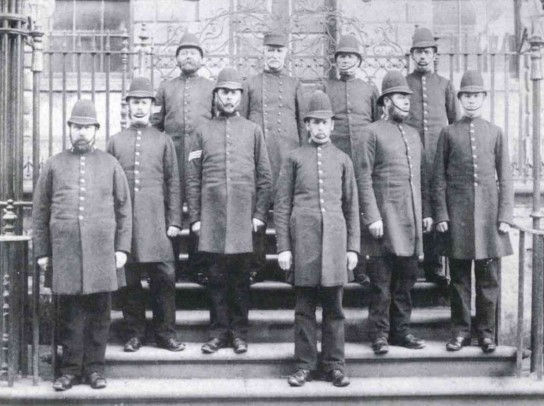
The Police Force was very much under the control of the Borough Council through the Watch Committee, who drew up the Rules and Regulations which were then agreed by the full Council before being sent to the Home Office for endorsement.
In 1842 the regulations insisted the police constables wore their complete uniform when on duty. They were all issued with their own numbered personal truncheon, which had the Royal Cypher and the Borough Crest. The truncheon, in addition to being for personal protection, was also their authority, and was similar to a warrant card today. One of their responsibilities was to visit public houses during the hours of divine service on a Sunday to make sure that no intoxicating liquors were being sold or consumed. Another duty was to look out for gambling on a sabbath. This involved visiting the outlying areas of the town where groups of men would congregate to play cards for money, Uffington Meadows being a favoured spot.
The problem that these early policemen had was, when chasing fugitives, they needed to catch the individual before he/she crossed the Borough boundary, because their authority vanished once they crossed the border. On one occasion, wrongful arrest was successfully claimed when the individual was apprehended on the south bank of the River Welland in the Parish of Barnack.
New regulations were made in 1857 which included the provision that all constables had to have his rank and number put in a conspicuous place in front of his premises. The name and addresses of the Policemen started to appear in local directories, so everybody knew where they lived.
In 1873 for instance the police force was made up of: -
Mr Richard Ward, Chief Superintendent, 30 Scotgate.
John Harrison, Sergeant, 2 Austin Friars’ Lane.
David Leach, Sergeant, 3 Milner’s Row, Belton Street.
George Dalrymple, Acting Sergeant, 4 Milner’s Row, Belton Street.
No. 1 William Wade, Merit Class, 1 Palmer’s Buildings, Empingham Road.
No. 2 Francis Gray, Merit Class, 19 Belton Street.
No.3 Samuel Burrell, First Class, 9 Exeter’s Court, St Peter’s Street.
No. 4 John Martin, First Class, 58 St Leonard’s Street.
No. 5 Richard Wright, Third Class, 4 Welland Street.
In 1857, other changes included the creation of a structure within the police force with the introduction of sergeants and the removal of the gap between the Night Duty, which previously finished at 5.00am, and the Day Shift, which started at daylight. In the same year, consideration was given by the Watch Committee to amalgamation with the then newly formed Lincolnshire Constabulary. The decision was made to keep the local control, even though such a move would have resulted in a saving of £93 0s 0d.
The Stamford Borough Police Force was a well-managed force as it was described in 1861 as “one of the most efficient small forces in the district” by Her Majesty’s Inspector of Constabulary.
Chief Constables/Chief Superintendent
William Reed January 2nd 1836 to October 20th 1859 (died in office).
Richard Ward November 22nd 1859 to November 21st 1885 (retired).
Alfred Palmer November 26th 1885 to September 29th 1886 (required to retire),
(formerly a Sergeant in the Stamford Borough Police).
John William Lawson September 30th 1886 to March 11th 1889) (Chief Constable at Peterborough),
(formerly an Inspector of the Rotherham Borough Police).
On April 1st 1889, Stamford lost its independent police force and had to amalgamate with the Lincolnshire Constabulary as the Borough had a population of less than 10,000. However, for several years, Stamford remained as a separate division of the County Force.
Sources.
Jenkinson’s Royal Albert Almanack 1873
Lincolnshire Constabulary 1857 – 1957 (Author Unknown)
A print version can be downloaded HERE