Our next talk: Thursday, 5th November - Stamford and the Great Cecil by Mike Burton

Stamford Local History Society
Stamford Post Boxes: A History
By Trish Auciello
Introduction
Stamford is not unique … but it is unusual for a small town like ours to have post boxes from six different monarchs, from Queen Victoria to Queen Elizabeth II, all we are missing is King Charles III.
This article traces the historic locations and monarchs of post boxes in Stamford. It concentrates on Queen Victoria to King George VI, with a few notable ones from Queen Elizabeth II’s reign. Most of the historic information has come from the various directories, such as Dolby, which listed locations from 1855 up to 1939; unfortunately, these don’t give precise locations or the type of box, and there are some anomalies and omissions. Descriptions of the current locations of post boxes are correct as of April 2026.
First some background to set the stage for the entrance of the post box.
The Postal Service before 1840
The first letters were carried by horse, with recognised places and persons responsible for providing horses and post-boys, and many old hostelries were used, including Stamford, which was the 8th stop on the London to Berwick route, later extended to Edinburgh. Mail coaches on the London to Edinburgh route were introduced in 1786.
In the 1830s, postal rates were expensive and anomalous, charged by the number of sheets (no envelopes) and the distance travelled. The recipient paid the postage upon delivery and this system was subject to abuse e.g. if the recipient recognised the writing and knew that their relative was well enough to write, they could refuse to pay the postage, leaving the Postal Service out of pocket. It was usual for the sender to take the letter to the receiving office themselves, which could be some miles away, although some places had a Bellman who would collect mail. Records were kept of each letter, sender, and recipient, which was a major administrative burden.
The Penny Black
Sir Rowland Hill conducted a review of the Postal Service in the late 1830s and recommended a much cheaper, pre-paid system, using an adhesive stamp to show that postage had been paid. This started in May 1840 with the introduction of the Penny Black stamp. It cost one penny for letters up to half an ounce (14 grams) no matter the distance. Hill’s thinking was that a cheaper system meant more people would send letters and eventually lead to profits. He was proved right as nationally the number of letters sent more than doubled in 1840. In Stamford itself, an average of roughly 1,700 letters was sent each week in November and December 1839; in one week in January 1846, this had risen to 5,760.
Post Boxes
With the increase in mail, a more efficient system was needed to collect letters ready for the mail trains. Anthony Trollope, now more famous as a novelist, worked for the Post Office as a surveyor, and had probably seen roadside letter boxes in France and Belgium. He proposed a similar system in Britain, and a trial started with four boxes in Jersey in 1852 and others in Guernsey in1853. None of these boxes remains in use.
The first post box in mainland Britain was installed in Carlisle in 1853. There was no standard design, although nearly all were pillar, but some were fluted, others hexagonal, or had ornate decorations. Some early boxes had vertical slits, with an internal flap that moved to the side. By 1857, horizontal slits were usual with a flap over the aperture and a protruding cap. Wall boxes first appeared in 1857, and lamp boxes in 1896. The “Resources” section, at the end of this article, lists books and websites where more information can be found on the progression to the boxes used today.
Cyphers
As the Royal Mail service, nearly all post boxes show the cypher of the monarch at the time they were manufactured. There are some without a cypher, known as “anonymous” that were issued in error. Here are the names of the monarch, their dates, and their cypher. The small Victorian wall boxes just show the initials VR. An interesting side thought – Edward VII was a colourful character and his cypher has a flourish to it, by contrast George V was a quiet, reserved man. His cypher shows only “GR” and not “GVR”, as he was the first George with post boxes and felt “GR” was quite sufficient.

Stamford’s First Post Box
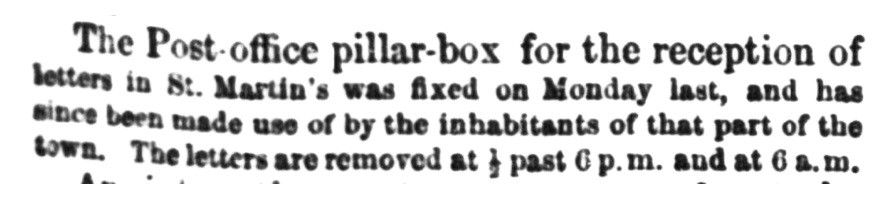
The first post box in Stamford was installed on High Street St. Martin’s in October 1855 in the same year that London installed its first post boxes. This was in the reign of Queen Victoria (VR 1837-1901) and was reported in the Stamford Mercury on Friday 26th October 1855.
The black and white photograph below shows the box outside St. Martin’s Church; it probably wasn’t a coincidence that it was opposite the Burghley Estate Offices. The post box appears to be hexagonal, and may have been similar to this one still in use today in Framlingham, Suffolk.

I don’t know how long this box remained in use, whether in this location or elsewhere. A sub post office was opened in High Street St. Martin’s in 1897 closer to the town bridge; a photograph in the Francis Frith collection of the post office doesn’t show a post box outside it – did people still use the old box, in its original location, or perhaps relocated nearer the bridge? The current box on St. Martin’s, near the corner with Water Street, is a George V (GR 1910-1936) pillar box. This box has the remains of a frame on top which would have held a sign showing the direction of the nearest post office.

Stamford’s Second Post Box

The Stamford Mercury in December 1959 mentions that the post master had applied to install an “iron letter-box somewhere in St. Peter’s-street” and a meeting was arranged to choose the location. The book “Stamford Postal History” gives the location as Tinwell Road, perhaps they meant “the road to Tinwell”?
It was described as the “new type”, probably a cylindrical pillar with a horizontal aperture, not that different from modern boxes. In the directories, the location is sometimes described as St. Peter’s Hill and sometimes as St. Peter’s Street. In 1896, Potter’s Directory says Hill and Dolby’s says Street. The black and white photograph below dates from 1913, and shows a box outside 32 St. Peter’s Street, which was the yard of John Woolston, a well-known local builder. In more modern times, it was a car dealership, and is now the Stamford Eye Clinic. The current box is a George V pillar box outside 22 St. Peter’s Street. This used to be a hardware shop and is now a firm of accountants.

Victoria (1837-1901) Boxes still in use
There is only one Victorian pillar box still in Stamford, it’s on St. Mary’s Street, opposite St. Mary’s Hill, and was installed around 1896-97.
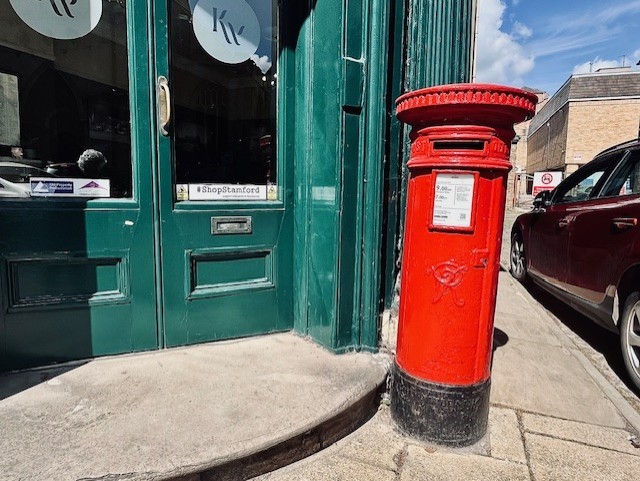
The other Victorian boxes still in Stamford are all wall boxes. There is one on platform one at the Rail Station, installed between 1868 and 1871. Another is on Scotgate, installed at about the same time. It’s outside number 48, part of a kitchen showroom.

The last remaining VR wall box is in Torkington Street, in the wall of a now closed sub post office. The sub post office was previously on Casterton Road; when the post office moved to Torkington Street, the box moved as well. However, the directories don’t show a box on Casterton Road until 1909, during the reign of Edward VII (EVIIR 1901-1910) and Torkington Street is not mentioned at all.

Previous Victorian Post Boxes
Wharf Road – the directories show a box on Blackfriars Street from 1874 to 1896, then one on Wharf Road from 1897 onwards. Did the box move or was it described differently? At some stage, the box has been changed to an Eliabeth II (EIIR 1952-2022) wall box, opposite the entrance to the Wharf Road car park.
Conduit Road 1891-1896, Recreation Road 1897-1903, Bentley Street Sub Post Office 1904 onward - these three boxes pose a conundrum. It seems too much of a coincidence that the dates they appear in the directories follow on if they’re not connected in some way. Perhaps Conduit Road was a wall box, with a small capacity.
The roads north of New Cross Road were being developed around this time, and Recreation Road would have seen more foot traffic than Conduit Road, and a pillar box may have been installed here to handle a larger volume of mail. The same box was probably described as Bentley Street sub post office, when it opened, as it was only about 50 yards away. The current box on Recreation Ground Road is an Elizabeth II, recently converted to solar.
High Street first appears in the directories in 1876, described as being near the (fire) engine house, which was at the back of the portico – the current library building. The portico was a butcher’s market with the police station in the small section on the left. The present box is an Elizabeth II pillar box at the front of this section.

St. Paul’s Street – another conundrum. The earliest mention is in 1872, exact location or type unknown, and the latest is 1882, both very much Victorian. The current box is an Edward VII wall box outside what locals will know as the Boys School/Grammar School/Stamford Endowed School, however this box is not mentioned in any directories up to 1939. Did this box move from another location in town, but why isn’t it mentioned?

Tinwell Road, first mentioned in 1891, so not the location of the second post box as “Stamford Postal History” stated. Its exact location and type are unknown. There are two boxes currently: a George V (GR 1910-1936) pillar box at the bottom of Roman Bank, and an Elizabeth II lamp box at the corner of Exeter Gardens.

Water Street, there is a box listed as near the Iron Bridge (Albert Bridge) between 1876 and 1937, type unknown. In 1938, it has moved to Newtown, which rises from the end of Water Street to Barnack Road. The change in location may have been to bring it closer to Stamford East Station; was the same box moved or was a newer one installed? The current box is an Elizabeth II lamp box outside the old station building.
Wothorpe Road was first mentioned in 1898, lastly in 1934. Was this actually Wothorpe Road in town or outside near Wothorpe itself? There was a sub post office on High Street St. Martin’s and a box at the station so would a box on Wothorpe Road have been necessary?
Edward VII (1901-1910) boxes
There are only two Edward VII boxes in Stamford, the wall box previously mentioned on St. Paul’s Street, and another wall box on the corner of Priory Road and Cherry Holt Road installed 1909-1910, the photo below is a close up of the cypher.

Possible other Edward VII boxes
Broad Street, this was first mentioned about 1905, presumably Edward VII but it may have been a Victoria box being reused. It was a wall box at the junction with Ironmonger Street, the outline of the box can still be seen, although partly hidden by an electricity box. The current box is an Elizabeth II pillar box next to Browne’s Hospital. Was this a direct replacement or had the earlier one already been replaced? If an Edward VII, was it moved to St. Paul’s Street?

Queen Street, a box was installed in 1905; as with Broad Street, we can’t be certain if it was a VR or EVIIR. The current box is an Elizabeth II wall box.
Empingham Hill/Road, the first mention of a box is in 1909, would this have been at the lower end when there was a VR wall box close by on Scotgate, or was it further up, near or at the present location? The current box is a George VI (GVIR 1910-1936) wall box on the corner of Empingham Road and Foundry Road.

George V (1910-1936) post boxes
I’ve already mentioned three George V pillar boxes in Stamford: St. Martin’s, St. Peter’s Street, and Tinwell Road. There are two other pillar boxes in town:
Ermine Way, near the junction with Empingham Road. this is not mentioned in the directories up to 1939, perhaps a re-used GVR box was installed after WWII.

Sussex Road, on the corner of Cornwall Road, probably described as New Cross Road in the directories, and first mentioned in 1934. This has an attached red painted drop box, where the postal service left mail waiting to be delivered to individual addresses. This is the only attached drop box in town, all the others are lamp boxes, and grey in colour. They are not used nowadays.

There are only two GV wall boxes in Stamford:
Radcliffe Road, in the wall of the cemetery, first mentioned in 1939 when it should have been George VI, another box being reused, but from where?
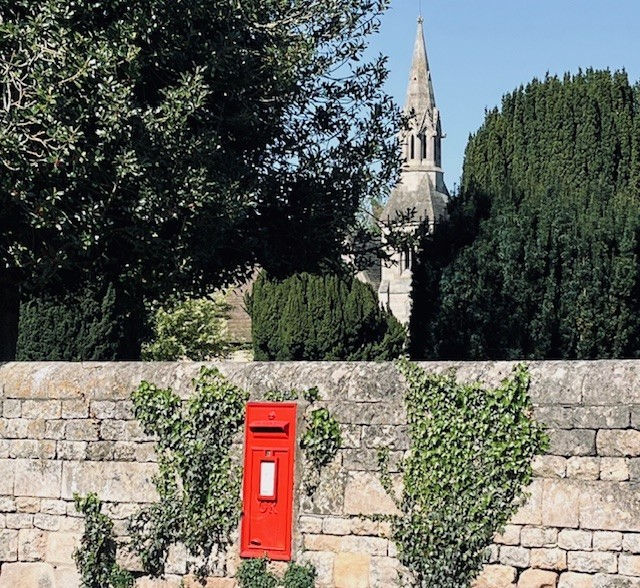
Kesteven Road, outside the shop, previously a sub post office. This is another anachronism: George V was king between 1910 and 1936, Kesteven Road post office was opened on 1st February 1957. I have no way of telling where the box came from, whether it was relocated from Stamford or elsewhere.

Edward VIII – the jewel in the crown
The Dolby Directory first lists a post box on Ryhall Road in 1908, which was probably Edward VII. The description of the location was changed to Ryhall Road sub post office in 1924. The photograph below shows the Burghley Tea and Coffee Tavern, incorporating the post office, with a wall box by the door. Unfortunately, the photograph isn’t clear enough to show the cypher.
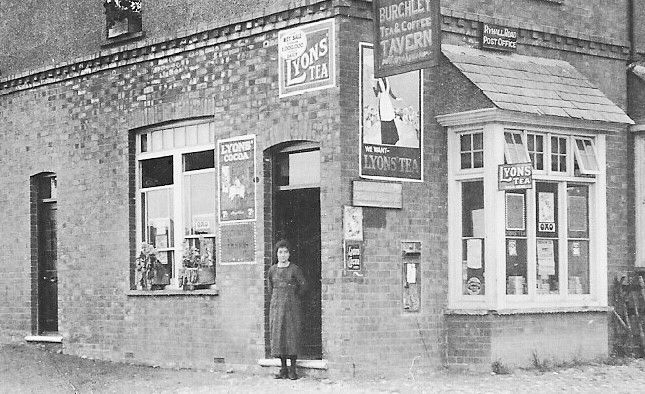
Edward VIII only ruled from 20th January 1936 to 11th December 1936. There were about 270 boxes manufactured during his short reign, but many were altered after his abdication, with the doors being replaced. It’s estimated that about 160-170 remain, and we have one in Stamford, which was installed as a pillar box outside the sub post office mentioned above. This is now a barber’s shop.
The sub post office has had alterations to the entrance, and an extension was built in the late 1960s. It looks as if the front has been replaced as there’s no sign of the earlier box in the modern brickwork. If it was Edward VII, is it a candidate for the St. Paul’s Street box?


GEORGE VI (1936-1952) boxes
There are three George VI pillar boxes in town:
Casterton Road, as previously mentioned, it would have been a VR or EVIIR when first included in the directories in 1909. The current GVIR box is north of the traffic lights, not far from Vence Close. This is on the grass verge and is sinking into it, the ground is almost up to the bottom of the door.

Lindsey Road, on the corner of Kesteven Road, this must have been one of the last George VI boxes to be installed in town, as the houses on Holland Road, Lindsey Road, Witham Close, and Kesteven Road were first inhabited in 1950.

Rutland Road, on the corner with Lincoln Road, probably installed post WWII. The door of this box is also almost at ground level, in this case because repeated tarmacking has raised the level of the foot path.
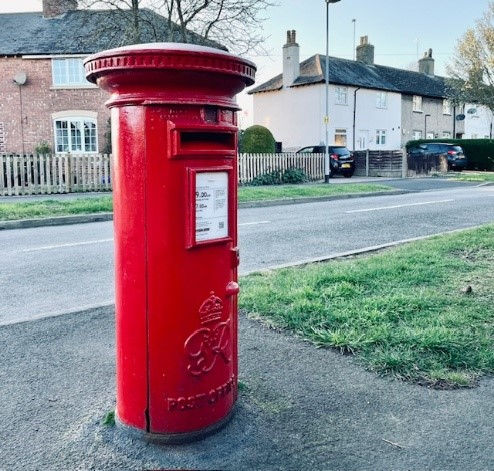
There are four George VI wall boxes in town:
Empingham Road, on the corner with Foundry Road, as previously mentioned.
Little Casterton Road, near the junction with Lambeth Walk, opposite the shop, not mentioned in the directories so probably post WWII. This box is a little shy and can often be found hiding in the ivy.

Stamford Post Office, All Saints’ Place. These don’t have a cypher but they are in the extension to the building that was built in 1937.

Elizabeth II (1952-2022)
I’ve mentioned some of the Elizabeth II boxes already. A full list of all of them is at the end of this article.
Solar Boxes
Two Elizabeth II boxes have recently been converted to solar in Stamford, on Recreation Ground Road and outside the Stirling Road post office. They have been fitted with new caps with a solar panel and the doors have been altered with a larger aperture so they can take parcels up to a shoe box in size. The solar panel provides power for an app which is needed to send parcels, provide proof of posting etc. Royal Mail have said they will only change Elizabeth II boxes, so our Edward VIII should be safe.

Charles III (2022- )
We don’t have a Charles III post box in town; Royal Mail don’t proactively offer to install new boxes but communities or new estates can ask for a box to be installed if they show a need and no other boxes are close by. The new estate on what was Williamson Cliffe’s old works doesn’t have a box, and with new estates being planned for Ryhall Road and possibly Casterton Road, we might see a Charles III one day.
Summary
As with most historic research, even with such relatively modern events, it’s difficult to achieve complete accuracy. I hope you’ve gained some interesting knowledge, even with the questions and puzzles that remain. I have also written a self-guided walk, about 60-70 minutes long, around the boxes of six monarchs in the town centre, which can be found on the Stamford Local History Society website.
Trish Auciello
© May 2026
Acknowledgements
Thanks are due to:
Chris Hunt, Chair of the Stamford Local History Society, who first sparked my interest, and who provided the old black and white photographs. All other photographs were taken by the author.
Paul Hewitt, committee member of the Letter Box Study Group, who set this process in motion by asking if I knew where Stamford’s 38 post boxes were.
Lea Rickard and the staff at Stamford Library for their help with the directories.
Resources
Books:
Stamford Postal History, by W G Stitt Dibden and L Tebbutt – out of print but Stamford Library has a loan copy
Old Letter Boxes, by Martin Robinson (Shire 2000) ISBN 978 0 74780 446 8
The Letter Box – a History of Pillar and Wallboxes, by Jean Farrugia (Centaur Press 1969) ISBN 978-0900000140
Pillar Boxes, by Jonathan Glancey (Chatto and Windus 1990) ISBN 978-0701134471
Online:
The Letter Box Study Group www.lbsg.org
Various Facebook groups
Twitter/X – #PostboxSaturday, usually not for technical information but interesting photographs of post boxes in the UK and worldwide
A walk around Stamford town centre post boxes www.stamfordlocalhistorysociety.org.uk
Museums (check out their websites as well):
The Postal Museum, London WC1 – www.postalmuseum.org
Colne Valley Postal History, Essex – www.cvphm.org.uk
Oakham Treasures, not in Oakham but near Bristol – www.oakhamtreasures.co.uk
Other Interesting Boxes not found in Stamford (hint: Lincoln is a good place to visit)
Penfold – a standard pillar box design between 1866 and 1879, very popular but expensive to make – there’s one in Lincoln in Exchequer Gate near the Cathedral. Modern copies can be found near tourist sites or other attractions.
Gold – the above box in Lincoln has been painted gold, in honour of Paralympian Sophie Wells after the 2012 London Olympics. Search online for a full list of gold boxes.
Double – the closest oval double boxes are in the centre of Bourne, the centre of Market Deeping, and in Cathedral Square, Peterborough. There is one on Clacketgate in Lincoln, west of the High Street.
Rectangular double – on the High Street in Lincoln.
Edward VII pillar boxes are quite unusual, there’s one on Clacketgate in Lincoln, east of the High Street.
Edward VIII wall box, in Bawdsey, Suffolk. Possibly the only EVIIIR wall box remaining, it’s a Ludlow type used by sub post offices.
Charles III – the first one, a pillar box, was installed in Cambourne, west of Cambridge, in July 2024.
Stamford Post Boxes – the full list as at April 2026 is here:
Victoria – VR
Pillar - St. Mary’s Street, outside King West estate agents
Wall - Stamford rail station, on the platform
Wall - Scotgate, outside the Home kitchen showroom
Wall - Torkington Street, off Casterton Road
Edward VII - EVIIR
Wall - St. Paul’s Street, outside Stamford School
Wall - Priory Road, on the corner of Cherry Holt Road
George V - GR
Pillar - St. Martins, opposite the George Hotel
Pillar - St. Peter’s Street, next to the accountants
Pillar - Tinwell Road, on the corner of Roman Bank
Pillar - Ermine Way, on the corner with Empingham Road
Pillar - Sussex Road, on the corner of Cornwall Road
Wall - Radcliffe Road, in the cemetery wall
Wall - Kesteven Road, outside the shop
Edward VIII - EVIIIR
Pillar- Ryhall Road, near B&M. Very rare, probably about 160 still in existence.
George VI - GVIR
Pillar - Casterton Road, just north(ish) of the traffic lights
Pillar - Lindsey Road, on the corner of Kesteven Road
Pillar - Rutland Road, on the corner of Lincoln Road
Wall - Empingham Road, on the corner with Foundry Road
Wall - Little Casterton Road, opposite the shop, on the corner of Lambeth Walk
Wall – Stamford Post Office, All Saint’s Place – no cypher
Elizabeth II - EIIR
Pillar - High Street, outside the library
Pillar - Broad Street, near the War Memorial
Pillar - Recreation Ground Road, opposite the end of Bentley Street
Pillar - Green Lane, on the corner of Edinburgh Road
Pillar - Sutherland Way, outside the shops (Stirling Road Post Office)
Pillar - Morrison’s lobby
Lamp - Barnack Road, near Abbot’s Close
Lamp - Water Street, outside Welland Mews
Lamp - Tinwell Road, on the corner of Exeter Gardens
Lamp - Lonsdale Road, opposite the Danish Invader
Lamp - Caithness Road
Lamp - Arran Road
Lamp - Primrose Way 1
Lamp - Primrose Way 2
Lamp - Hardwick Road, on the corner with Casterton Road
Lamp - Cambridge Road, on the corner of Charles Road
Wall - Wharf Road, opposite the car park
Wall – Queen Street
A print version can be downloaded HERE