Our next talk: Thursday, 5th November - Stamford and the Great Cecil by Mike Burton

Stamford Local History Society
The Battle for 51 High Street, Stamford
By Richard Asher
The story of a Listed Building and the battle to save it in the 1960s
A talk given for the Stamford Local History Society on 4th Dec 2025.

The property pictured was 51 High Street Stamford This photograph was probably taken in the 1930s.
In the 1960s, it became a battleground between the modernisers and the conservationists, as equally important locally as the famous battle for the Euston Arch was in London.
I particularly want to talk about No. 51. That is because for me this is a personal memory. Although I was not involved in the dispute itself (I was still at school at the time), this building is part of the reason I was born in Stamford, my home town, and the town whose history has come to mean so much to me.
So, let me explain. My dad, Fred Asher, was born and brought up in the tiny village of Dunsby, the other side of Bourne. When he was 14, he left school and started to work as an office boy for a local business in Bourne called Longstaff and Lyall Ltd. They were auctioneers and land agents. He eventually became an assistant to Thomas R Lyall, one of the directors.

After the war, having been in the army, my dad returned to work for Longstaff and Lyall at Bourne.[i] However, in 1947, Thomas Lyall asked him to run the Stamford office. In 1949, my dad married my mum, and they set up home in Stamford. I was born the following year in Stamford Hospital. Longstaff and Lyall occupied 51 High Street as their Stamford office. The Company had been based there since about 1938.
Subsequently, my dad became a qualified Auctioneer and a Partner in the business (see left).
So, you see, if my dad had not been sent to the Stamford office at 51 High Street, I may never have been born in Stamford.
No. 51 was thought to date back to at least the 1600s and had been at different times, a public house (The Windmill), a school, and a private house. John Daffurn’s book “Stamford Assets” recalls that it was one of the buildings acquired by the Newcombe family in the nineteenth century and recounts two unusual deaths that occurred in the building[ii].

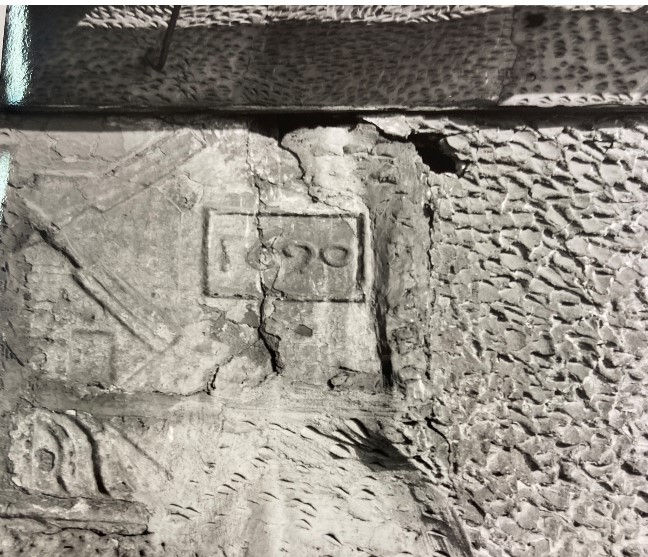
This photograph shows the front of the building just before it was demolished. (Photographs RCHM) On the back of the building in the pargetting, you can just about make out the shape of a windmill, and next to it a date “1690”. It is not clear if the two images are connected, but in his book “Stamford Pubs and Breweries” Martin Smith speculates that it could have been one of the larger Inns of the town[iii].
I remember the building well from the early nineteen sixties. What was it like inside? Well, the photograph below gives some idea of the main office on the ground floor and, yes, that is me aged about 14 in the centre of the photograph.

The place was in poor repair and the facilities limited, just one toilet used by all the office staff, who numbered about 7 or 8 people. There was no hot water, and no central heating, with just very ancient gas fires. The only way to wash the tea pot and mugs was to disconnect the gas pipe to the fire in the general office and reconnect it to a gas ring on which to boil the kettle. The same process was repeated, once the mugs had been washed and dried, to make the tea. Only then could the gas fire be re-connected, until the next time tea was required!
I also recall being sent to collect a sheet of hardboard from Scholes’ shop at 3 Ironmonger Street. This sheet was to put over the wooden floor in one of the first-floor offices, as the typists had been complaining that their high-heel shoes were getting caught in the holes in the floorboards!
In those days I had no idea what a Listed Building was or what it meant. But subsequently I discovered that the building had been subject to a Building Preservation Order and was a Grade II listed building.
Around 1963, the owner of 51 High Street was approached, along with the adjoining owners at 46, 47, 48, 49, & 50 High Street and 4, 5, & 6 Maiden Lane, by the Pearl Assurance Company Limited with a view to the Insurance Company acquiring all of the properties on the High Street between the then Co-op Drapery store (now Weird Fish & Magnet Kitchens) and the National Westminster Bank branch, on the corner of Maiden Lane (now Starbucks). Pearl Assurance were a major player in the insurance industry. They were, like all the large insurance companies of the day, heavily into property development as a way of investing for future returns. They had decided that Stamford was ripe for a development of new shops, and particularly a branch of one of the fast-expanding national supermarket chains. In those days, there was no such thing as “out-of-town shopping” or hypermarkets and a 6,000 sq. ft. “in town” supermarket was considered the right size for a town such as Stamford.
It should also be remembered that, in those days, Stamford High Street was still a main road. Rear servicing was an important requirement to prevent serious traffic hold ups on the High Street. Thus, the plan was to build a new Tesco supermarket, and 4 new shop units, with offices above. All the shops would be serviced from an access in Maiden Lane. This plan required the demolition of 47 to 51 High Street and 4 to 6 Maiden Lane. The battle lines were drawn.
The situation was quite complex. On the conservation front, in favour of retaining the listed buildings (which were 51 High Street and 5 & 6 Maiden Lane) were the relatively newly formed Stamford Civic Society and some of Stamford Borough councillors. On the other hand, others of the Stamford Borough Council members were all for the modernisation of Stamford. The County Council – in those days the Kesteven County Council was also split. The Ministry of Transport, who had a say because the High Street was part of the A16 Stamford to Boston Trunk Road, wanted the development to go ahead because it would allow them to insist on the building line being set back to permit them to almost double the road width at this narrow part of the High Street.
The debate went on for over 3 years as to whether the buildings should be demolished. Site meetings were held between Stamford Borough Council, Kesteven County Council, and the developers. Plans were revised and resubmitted. Eventually, it was agreed that all the buildings on the High Street should be demolished (including 51), but on Maiden Lane only No 4. It was decided that 5 & 6 Maiden Lane should be saved from demolition. Also, the new building erected at No 4 Maiden Lane must incorporate the doorway to the Albert Hall (at No. 46 High Street) which was to be taken down and rebuilt in its new position – at the back of No 4 Maiden Lane, where it remains to this day – where few people know it exists – and usually it is hidden by dustbins.
The Department of Transport did not fully get its way either. The building line was to be set back, but only by 3 feet, leaving a slight dogleg in the pavement between the new development and the bank (now Starbucks). But, then, in the 1970s, the High Street became a pedestrian precinct anyway!
So, the demolition of 51 High Street got underway in the summer of 1966. But that was not the end of the story. During demolition, what was described by the Royal Commission on Historical Monuments as “a painted studwork wall C1600”[iv] was discovered. The photograph shows the wall in situ soon after it was discovered.


Urgent discussions were held, and it was agreed that the wall should be removed for conservation. This photograph (on the left) shows a remarkable painted panel from the wall soon after conservation. The wall is now in the Stamford Museum Store carefully protected by a Perspex screen. The story of its removal and its remarkable journey from Stamford to Lincoln and back to Stamford would provide enough material for another article.


Also, found “built into the chimney was a limestone panel”[v]. This proved to be the stone in this photograph. The inscription has been translated[vi] as:
Ye who enter this house
Pray for Blanche wife of Lord Wake
Daughter of Henry Earl of Lancaster
On whom God have true mercy.
It is believed that this was the memorial stone for Lady Blanche Wake, daughter of Henry Plantagenet, 3rd Earl of Lancaster. She was the great grand-daughter of Henry III. It is thought
that she was buried in the Greyfriars Church in Stamford in 1380. How the stone found its way to the High Street is not known, but it could have been used as building material after the dissolution of the monasteries in the 1530s.
The fully restored stone is now on the north wall of St George’s Church where the above photograph was taken.
In conclusion, should 51 High Street have been allowed to be demolished? In my view it should not. Although dilapidated, and in need of substantial modernisation, it could have been repaired and conserved. However, the conservation movement, was not as advanced then as it is now.
Whilst the property was a Listed Building, there was no conservation area legislation allowing planners to consider individual buildings in the wider street view context. Historic Buildings could only be considered on their own merits, not as a contribution to the street scene.
On the plus side, if the building had not been demolished, we would never have been able to see two magnificent medieval artifacts which we have today – the painted wall and the Wake Memorial. Also, within a year or so of its demolition, Stamford was designated the first Conservation Area in the country under the new Civic Amenities Act – I like to think that this designation as the first Conservation Area was spurred on by the response to the demolition of 51 High Street.
My boyhood memories of 51 High Street, helped me to appreciate the historic buildings of Stamford even more.
[i] The firm name was changed in the 1950s to just Lyall & Co.
[ii] “Stamford Assets a catalogue of Newcombe Family Property”, John Daffurn, Eptex 2024.
[iii] “Stamford Pubs and Breweries” Martin Smith, Spiegl Press 2006
[iv] The Town of Stamford, A Survey by the Royal Commission on Historical Monuments” HMSO, London 1977
[v] ibid
[vi] Taken from “Grey Friars or White Friars? In search of Stamford’s Friaries”, Linda Ball, Chalybate Books, 2021.
A print version can be downloaded HERE