Our next talk: Thursday, 5th November - Stamford and the Great Cecil by Mike Burton

Stamford Local History Society
Search Results
Search this site
232 results found with an empty search
- Harriet Swanson and William Blades.
< Back Harriet Swanson and William Blades. Two 19th-century market traders Keith Hansell 2024 When writing my book ‘Stamford Fairs & Markets’ I tried to add flesh to the bones of those who once sold their wares within the town, whether on a daily basis, or at one of the town’s weekly markets. It was inevitable that some would slip through the net, only to be discovered once the book had been published. William Blades, a fishmonger of Stamford, and Harriet Swanson. a butter seller from Belmesthorpe, were two such people. Harriet Swanson ‘ Suspected Child Murder at Stamford’. That was the headline from a report in the Stamford Mercury on Friday the 6th of October 1845. Harriet Swanson, a single woman of about 24 years of age, had gone to the Shepherd and Shepherdess public house around 1pm, as per usual, before leaving to sell butter in the Friday market. When returning around 6pm, she asked the landlady, Mrs. Sanderson, if it was possible to stay the night. Whilst being shown her room she announced that she was about to be confined and begged that she might not be turned away. About an hour later, at Swanson’s request, Mr. Edward Barber, surgeon, was called and was quickly in attendance. On entering the room he found the prospective mother in bed, with a man sitting by the bed-side smoking a cigar. After the man had departed, she told Mr. Barber that her name was Elisa Deacon, and that she resided with her brother and sister at Oakham and had come to Stamford thinking she might be better managed, having neither father nor mother. At eleven that evening she gave birth to a ‘ perfect and healthy’ female. When returning the following morning, Mr. Barber again found the child in good health and laying beside her mother. When asked if she had put the child to breast, she replied she had not, as she intended to “ put the child out ”, and that the nurse, who was in attendance, had the care of feeding her. On the Saturday afternoon, Swanson said that her daughter had made some gurgling noises in her throat. About six that evening, when the nurse took the child from its mothers arms, the child’s face and hands were black but it came to again after only a few minutes. After returning the child to its mother, the nurse left the room for a few minutes, but quickly returned when the mother called out that her child was dead. Mr. Barber was immediately sent for and on his arrival undressed the child but found no marks of violence, except a slight indentation on the upper lip, like the mark of a single finger-nail. The following day a post mortem examination took place but found nothing to indicate the cause of death. The inquest that followed lasted for four hours, and in the course of the investigation, Mrs. Sanderson admitted that Swanson, and the man seen on Mr. Barber’s first visit, often met at her house, sometimes going into the bedroom but generally into the front parlour. Swanson also stated that William Templeman, of Carlby, was the child's father and that he gave her a sovereign on Friday night to meet her immediate expenses. William Blades Or ‘ Pugnacious Blades’, as the Stamford Mercury headline called on Friday July the 18th 1862. Below is the transcript of that report. “A Fight, which though short was anything but sweet for one of the combatants, occurred between two fishmongers of Stamford named William Holland and William Blades, in the fish-market at the Portico on Monday morning. There seems to have formerly been a kind of partnership between the two present rivals. They had both been indulging too freely in beer, and the dispute arose in consequence of Blades attempting to carry off a box of herrings, which he fancied belonged to him. To this course, however, Holland strongly objected, having an impression that he was being robbed and high words ensued, which ended in a scuffle: the boxes were smashed, and the herrings strewn over the pavement. The disturbance being upon the very threshold of the police-station, acting-sergeant Leech interposed threatening them with “durance vile” if they did not desist. In defiance of this caution, however, they resumed the fight with increased animosity and violence, but were at last separated and locked up until their passion had cooled. They were ordered to answer for their drunken and disorderly conduct at the police-station on the following morning, but Blades was so severely punished and his vision so obscured, both eyes being deeply mortgaged, that he could not find his way to the station: the case was therefore adjourned till Wednesday, when they appeared before the Mayor (R. Bromhead, Esq.). and Edward. Cayley, Esq., and were discharged. Blades face showed such strange inequality of surface and variety of that, as would have been tested to their utmost the enamelling abilities of the notorious Madame Rachel”. Notes. The Shepherd and Shepherdess public house was located in Castle Street, Stamford, and was first recorded in 1831, later changing its name to The Castle and finally closing in 1959. From the sale particulars of 1893 it consisted of a parlour and smoke room located at the front of the building, with the bar and tap room behind. It also had five bedrooms, store-room, cellar and wash-house. The Portico, erected c.1807, stood in Stamford’s High Street, on a site formerly occupied by the White Lion public house. The fish market was situated behind the Portico, comprising two rows of covered stalls with a centrally placed pump. Market days were Monday’s and Friday’s. Blades vision must have been severely impaired as he only lived yards away from the police station in Rubbins Court on Stamford High Street. The report makes reference to a Madam Rachel, real name Sarah Russell, who operated a fraudulent cosmetic parlour in the 1860s, at 47a New Bond Street in London. She promised her female clients that she would make them beautiful forever but in truth she was no more than a con-artist, applying dangerous substances to her clients’ skin, with the inevitable results. A print version can be downloaded HERE Previous Next
- The End of Bull Running in Stamford
< Back The End of the Stamford Bull Run In 1838, the magistrates having received a peremptory mandate from Lord John Russell, for the suppression of the Bull-running, part of a troop of the 14 th Light Dragoons, from Northampton, under the command of Captain Harvey, and a detachment of the metropolitan police, arrived on the 10 th of November. The Dragoons were quartered in Saint Martin’s, Stamford Baron, in Northampton, with orders not to pass the bridge. The town and neighbourhood were in a state of great excitement on Sunday and Monday. The only two bulls in the town, one belonging to Mr. Roberts, at the Horns Inn, and the other the property of Mr. J. Smith, farmer, Scotgate, were secured by the police in the Hotel stables. On Monday night, special constables were placed at every entrance to the town to prevent the arrival of any bull. On the morning of the 13 th , the people congregated in large bodies, and chance threw a bull in their way. A covered cart passed through the town at twelve o’ clock, containing a young bull, the property of Earl Spencer, from his seat at Wiseton, near Bawtry. The bullards took possession of the cart in Saint Martin’s, where the bull was let out, and immediately ran down Saint Martin’s and over the bridge into Stamford. At the bridge the police formed themselves in line and made an attack on the people, to stop the bull, but it was useless: the bull passed on up Saint Mary’s-hill to Saint Geroge’s square, down High-street, Scotgate, Saint Peter’s-hill, and into the bull-meadow, where he was taken by the police, and escorted by the dragoons to the Bull and Swan, and given up to his conductor. The people passed into the back way of Saint Martin’s, near the Sun, where an attack was made on the military with stones and brickbats, principally from women and children; and an industrious harmless man named Nathaniel Pollard, who, whist returning from his work, was wounded on the head by the Sergeant major, and several people were hurt by the police. The military after leaving a guard at the Bull and Swan, drew up opposite to Saint Martin’s church and charged their carbines with ball bearings: they then marched through the streets and the mob quietly dispersed. At the following Borough Quarter Sessions in January, 1839, James Woodall, Octavious Snary, John Kisbee, and William Pollard , were indicted for riotously assembling with sticks and staves and breaking the peace by running a bull calf: Pollard was further indicted for throwing a stone at Robert Seal, a Sergeant-major in the 14 th Light Dragoons. The solicitors were, - Mr. N. Wilkinson, of Peterborough, for the prosecution, and Messrs. Thompson and Son, Stamford, for the defendants. After considering for a few minutes, the jury returned a verdict of not guilty . In 1839, notwithstanding the precautionary measures adopted by the Magistrates under the direction of the Secretary of State, - the introduction of military and a London police force, - the appointment of special constables, - and the establishment of mounted scouts to perambulate the open fields, - the bullards on Wednesday, November 13 th , contrived to introduce a bull into the town, though only for a very short time. Captain Bell with 43 of the 5 th Dragoon Guards from Nottingham, and Inspector Pearce with 20 of the London police force, arrived in Stamford on Monday. Photograph taken of a picture in the Mayors Parlour, Stamford Town Hall. On Tuesday, Francis Butt, Esq. (the Mayor), with W. Hunt, J Roden, and R. Hunt, Esqs., Magistrates, swore in 90 special constables, and adopted every arrangement calculated to carry into effect the commands of Lord Normanby for the suppression of the bill-running. In the evening of Tuesday the metropolitan and the borough police took charge of the bulls of Mr. Smith of Scotgate, and Mr. Roberts of the Horns, and whilst they were conveying the animals down Ironmonger-street, they were assailed by a mob with paving stones: the promptitude and firmness of the police force, however, suppressed the riot at the expense of a few broken pates from their staves, and the bulls were locked up in a stable at the Hotel, and the following instructions were given to the constables. “Special Constables, when called out, have all the powers which belong to a Constable throughout the whole Jurisdiction for which the appointment is made. “They are each subject to a Penalty of £5. For neglect or refusal to serve, or to obey lawful orders for performance of the duties of office. “Any person assaulting or resisting a Special Constable whilst in execution of his office, or promoting or encouraging any other person so to do, is liable to a penalty of £20., or to be indicted for the offence. “The following arrangements have been made for to-morrow (Wednesday). “Horsemen are appointed to preamble the Fields. “Special Constables appointed to guard the entrances of the town, 87.-Messengers, 3.-Metropolitan Police at Town-hall. “Town police to perambulate the streets, and communicate with the magistrates at the Town-hall, every hour or oftener if necessary. “In case a Bull should appear to be run, or a riot take place, the whole of the Constabulary force immediately to fall in and concentrate and assist in suppressing the disorder, and in apprehending offenders. On Wednesday morning, at seven o’ clock, a horse patrol was placed in every direction at about the distance of a mile from the town, with orders to give instant notice in the event of any beast approaching towards Stamford. The Mayor and magistrates assembled at the Town-hall at eight o’ clock. - The soldiers also mounted guard at the George Inn, at the same hour. Parties now beginning to congregate in the streets, the magistrates issued the following order: - “Town-hall, Stamford. Wednesday, 13 th November, 1839. “The magistrates have directed that there should be no congregation or assemblage of persons in the streets; and the constables have strict orders to prevent any such occurrence. - By order, “Nath. Farrant, Clerk to the Magistrates” Everything remained tolerably quiet until between one and two o’ clock, when the cry of “the bull” was raised, and it was found that, in spite of the precautions adopted, a young bull, having a direction tied on it “for Stamford” – had been brought into the town from the fields North of Scotgate, was “run” across that street, up to Rutland Terrace, thence down Well-lane, and along Bath-row, to the Lammas bridge, where the water was very much out. Through the negligence, it is said, of some of the special constables – none of whom communicated to the Magistrates, as they had been directed to do, the circumstances of a bull’s having entered the town – the animal remained for some minutes about Lammas bridge; but as soon as the Magistrates became acquainted with the fact, Mr Reed (chief constable) and the borough police, with Superintendent Pearce and ten of the metropolitan force, proceeded to rescue the bull. This was not accomplished, however, until they had reached a distance of two miles from Stamford, near Tolethorpe, where the animal was found in the middle of the river, surrounded by several hundred people. Possession of the bull was immediately taken by the police, who proceeded to drive him towards Stamford, followed by the whole assemblage, with shouts and execrations. On nearing the town, the mob considerably increased, and symptoms of an attempting rescue becoming evident, a messenger was despatched for the remainder of the police force, and subsequently for the military, who arrived apparently in the exact point of time to prevent violence from the crowd, which now amounted to three or four thousand. Photograph taken of a picture in the Mayors Parlour, Stamford Town Hall. Stones were thrown at the police, and some severe blows given and received, when the appearance of F. Butt, Esq., Mayor, who headed the military, quieted these symptoms, and the bull was conduced into the town, between two files of dragoons, accompanied by the police, and followed by the many thousands who had further attempts at violence. collected, with shouts, but with no further attempts at violence. Photograph taken of a picture in the Mayors Parlour, Stamford Town Hall. The animal was then taken into the Hotel stables and secured, after which the mob dispersed, and the military and police withdrew. While the bull was being secured as above in the Hotel stables, an attempt was made by an individual to let loose another animal secured in the same place, by withdrawing the staples of the stable door, but he was fortunately observed by the police. The magistrates remained at the town-hall until a late hour, and the military and police were on duty till 10 o’ clock, when the town appearing perfectly quiet they retired, and no further commotion took place. The military remained in Stamford until the 15 th and the metropolitan police, after a few days, returned. The bull was claimed by Mr. Clement Bland, of Frith Lodge, who declared it to have been taken by violence from his premises, but by parties unknown. – On the dismissal of the military, the Mayor presented Captain Bell, in the names of himself and the other authorities, their thanks for his attention and zealous discharge of duty. SOURCE CHRONOLOGY OF STAMFORD BY GEORGE BURTON, 1846, PAGES 60 TO 65, PRINTED & PUBLISHED BY ROBERT BAGLEY Note: - The Stamford bull baiting and run was held on St Brice’s day the 13 th November for about 600 years until it was effectively supressed in 1839. A print copy can be downloaded HERE Previous Next
- The Saracen's Head Inn, Stamford: Uncovered? | Stamford History
< Back The Saracen’s Head Inn, Stamford: Uncovered? John Daffurn 2025 A recently posted snippet on this site (see here ) identified an unknown medieval inn included in Prof Alan Rogers’ People & Property in Medieval Stamford (838. MB 4/58). It refers to ‘le Sarsynneshed in the parish of St Mary at the Bridge Stamford’ which was being repaired in 1435. The post resonated with me as other information I had accumulated when researching for Stamford Assets had also identified a Saracen’s Head Inn. Now, with documentary evidence, it is possible to formulate a proposition regarding both the exact location of the inn and the likely date it was built. 1. The Location of the Saracen's Head 1.1 Introduction Whilst researching for Newcomb owned properties in St Mary’s parish, I came across a group of documents held by the Lincolnshire Archives (LA). Curiously the entry heading in the archive catalogue mentioned that the documents related to a building which was formerly known as the Saracen’s Head. At the time I was unable, before the publication deadline for Stamford Assets , to decipher and unravel the complex group of documents from 1663 to 1850, involving multiple buildings and parcels of land. Having revisited them, I believe it is now possible to identify the location of the inn and its owners and tenants, from 1663. 1.2 1721 Indenture – Gift from Joshua Blackwell to his son, John (LA, MISC DON 1064/6) The most detailed document in the group is a 1721 indenture setting out the terms of a gift of property in the Monday Market [now St Mary’s Place] from Joshua Blackwell to his son John, in consideration of John’s marriage to Mary Winder. The gifted property included three separate messuages or tenements ‘and all manner of Outhouses Edifices Buildings Dovehouses Barns Stables Coachhouses Yards Orchards Gardens Backsides Ways Waters Watercourses Walls Fences Easements Privileges Profits Commons Emoluments Hereditaments and Appurtenances’. This indenture also details the families (Fairchild, Kettleborough and Wright) from whom Joshua Blackwell purchased these properties, and this aids the research into the location of the old inn. One of the properties is described as having a ‘malting office’ which links to a property advertised to let in 1723 (see 1.4) and which in 1721 was tenanted by John South and Dr Charles Wilson. South had, in 1719, been the landlord of the Swan Inn [located at 15 St Mary’s Street and later called the Swan and Talbot, and then the Talbot] and was mayor of Stamford in 1722/3. The link between the Swan Inn and the malting house property is replicated in 1795 (see Sarah Broughton in 1.5). 1.3 Additional documents 1663-1721 Although the 1721 indenture does not mention the Saracen’s Head, the five earlier documents below all confirm the inn by name and relate to property acquired by Blackwell from the Fairchild family, and, by inference, the Kettleborough family. These documents all relate to ‘three lower ground rooms’ being ‘part of and belonging to a messuage or tenement called or known by or name of or sign of the Sarisons Head [also Sarizons Head]’. 1.3.1 1663 Indenture, Robert Cammock to Henry Fairchild (LA, MISC DON 1064/1) The Cammock family were well known in Stamford and had resided in St Mary’s parish since the middle of the 16th century. Robert’s father and his uncle, Edward, had both been aldermen of the Corporation of Stamford and, in 1643, Edward had carried the town mace in front of Charles I when he processed through the town. Additional information within the indenture states that a tallow chandler, Willian Algar, had occupied the property north of the Saracen’s Head and Robert Cammock also owned the building south of the inn. In 1661, Robert’s daughter, Sarah, was born and the St Mary’s parish register gives Robert’s occupation as innkeeper. A year later, Robert’s father died and, as a wealthy and important inhabitant of St Mary’s parish, it is likely that he owned both the Saracen’s Head, occupied by his son, and the property next door which was his home. Robert, his eldest son, would have inherited these buildings from his father and one scenario would be that Robert moved into his father’s house and sold or let parts such as the ‘the three lower ground rooms’ of what had become a failing inn. The indenture also describes the rooms above the lower rooms as being in the possession of William Algar and Robert Cammock. However, by 1672 these upper rooms were owned by Thomas Kettleborough (see 1.3.2) 1.3.2 1672 Indenture, Anne Fairchild to Richard, her son (LA, MISC DON 1064/2) Anne, the widow of Henry Fairchild who died in 1671, gifted the three lower rooms to her son Richard on his marriage to Susan Nelsy. At that time the lower rooms were being let to Joseph Parnham, who in 1672 married into the Fairchild family, and the upper rooms were owned by Thomas Kettleborough. 1.3.3 1674 Indenture, Richard Fairchild to Major Fairchild (LA, MISC DON 1064/3) In 1674, Richard Fairchild leased the three rooms for ‘four score and nyneteene years’ to Major Fairchild, a butcher, who one might assume was a relative. 1.3.4 1698 Quadrupartite Indenture (LA, MISC DON 1064/4) This document appears to be a tidying up of Joshua Blackwell’s property portfolio in St Mary’s parish, by acquiring the three lower ground rooms, having probably already bought the upper rooms from Thomas Kettleborough, as well as a larger property and land from Robert Wright. However, over seventy years remained on the lease in 1.3.3 above, and as Major Fairchild had died in 1690 his widow Elizabeth and daughter, also Elizabeth, inherited the lease. The four parties to the indenture were the widow and daughter of Major Fairchild, Richard Fairchild and Susan his wife, who owned the freehold, John Rogers [father-in-law of Joshua], who held the property in trust for Joshua Blackwell, and finally Joshua Blackwell himself, who was to purchase the freehold. 1.3.5 1698 Indenture, Richard Fairchild to Joshua Blackwell (LA, MISC DON 1064/5) This document conveyed the freehold to Joshua Blackwell, having concluded the lease arrangements in 1.3.4 above. The five documents above, plus the 1721 indenture, do not identify the exact location of the Saracen's Head but provide information which, when taken together wirh 1.4 (the Blackwell family) and 1.5 (documentary evidence from 1772 to 1850) below, clarifies the situation. 1.4 The Blackwell family Between 1698 and 1721 there is a paucity of documentation to assist in the location quest, but genealogical information can help. In 1686, Joshua Blackwell married Mary Rogers, the daughter of John Rogers, a doctor, who is mentioned in 1.3.4, and they would have needed a marital home. A few years before, probably in 1680, Robert Cammock died and in 1682 his daughter, Sarah, married Robert Wright. Both lived and remained in the parish of All Saints, so it is possible that Sarah inherited her father’s property in St Mary’s and sold it following her marriage, as Robert Wright and Sarah are named in 1721 as being one of the parties from whom Joshua Blackwell acquired property. The assumption is that Blackwell acquired Robert Cammock’s house and made it his home before buying the upper rooms of the Saracen’s Head from Thomas Kettleborough and the lower rooms from Richard Fairchild. He lived in the house with his wife, Mary, but in 1699, at the age of thirty-two, she died having born him five children, including his son John. In 1702, Joshua, then a widower, married Lettice Winder, a widow, and they continued to live in the same house until his death in 1727 and Lettice’s death in 1730, even though it had been gifted to his son John in 1721. When John married Mary Winder, the daughter of Lettice from her first marriage, Lettice became both his stepmother and mother-in-law. Stamford Mercury , 20 February 1724 In 1723, John Blackwell, following the death of Dr Wilson his tenant, advertised the house with the malting office to let (Stamford Mercury [SM], 6 June 1723) and a 1724 advertisement for the same property mentions it having a coach house and stable for seven horses. After the death of his father and stepmother, John Blackwell demolished his large house and built in its place what is now 2 St Mary's Place. A few years later he extended the house which became 3 St Mary’s Place. One is now able to realise that the location for the Saracen’s Head is the property north of Blackwell's home – 1 St. Mary's Place. When John Blackwell died in 1770, he left a detailed will bequeathing a house tenanted by Dr Jackson, to Miss Eleanor Peart, and his main residence to his son Thomas Blackwell, the rector of St Clement Danes, London. However, in a subsequent codicil, his will was amended to leave both properties to Peart. Thereafter, the trail of 1 St Mary's Place, and therefore the site of the Saracen's Head, is well documented. 1.5 Documents and other information for 1 St Mary’s Place, 1770 to 1919. 1 St Mary's Place The death of John Blackwell triggered the sale of the building that was previously the Saracen’s Head and from that date documentary evidence exists for the ownership of the property until 1919, when it appeared in an auction catalogue as 1 St Mary’s Place. Eleanor Peart, the grandniece of John Blackwell, inherited his two houses and proceeded to sell them both. No. 1 St Mary’s Place was sold in 1771 to John Hays (LA, MISC DON 1064/9) for £220, and in 1773 the large house was sold to Edward Nott. In 1790, Abel Walford Bellairs bought the large property (2/3 St Mary’s Place) and in 1793 bought No. 1 from John Hays for £336. This latter deal appears to be a mechanism to enhance the Bellairs’ larger property next door, as in 1795 he sold it on to Sarah Broughton for £315, after carving out some of the land at the rear. The indenture stated that Bellairs was selling the house ‘except such part of the premises as have been lately taken into the yard and premises of the said Abel Walford Bellairs and then divided therefrom by the fence wall and buildings of and belonging to him the said Abel Walford Bellairs’ (LA, MISC DON 1064/10b). When Sarah Broughton bought 1 St Mary’s Place, she was still the landlady of the Swan and Talbot Inn (previously the Swan Inn run by John South in 1719). Sarah Broughton retired in 1795 and moved permanently into 1 St Mary’s Place (SM, 17 April 1795). Over the years 1 St Mary’s Place passed through the heirs of Sarah Broughton until it was bought by Richard Newcomb for £400, in 1850 (LA, MISC DON 1064/12). The complete list of owners and tenants of the building from 1663 until its auction sale in October 1919 can be seen in Appendix A. 2. The Origin of the Saracen’s Head Inn, Stamford Example of image for Saracen's Head inn sign The Oxford Dictionary provides the meaning of Saracen as i. An Arab or Muslim at the time of the Crusades and ii. A nomad of the Syrian or Arabic descent. The ‘Saracen’s Head‘ is described as a heraldic charge or an inn sign, and although many inns named the Saracen’s Head remain in England the word Saracen can now cause offence. Its use as a name for an inn is almost certainly linked to the Crusades which were a series of wars in the Holy Land from 1096 to 1297. The English did not participate until the 2nd Crusade in 1147 when a few knights ‘took the cross’ [taking vows and joining a crusade] and travelled to Palestine. In 1187, Richard, as the Duke of Pitou, took the cross and later, as Richard I, he led the 3rd Crusade in 1190, with the support of an army of 6,000 Englishmen. It is known that there was support in Stamford for pilgrims and knights travelling to Jerusalem before 1189, in the form of the house of the Holy Sepulchre, a hospital of the Knights of St. John of Jerusalem, sometimes called Knights Hospitallers. This was situated on the south side of the River Welland on the site of the George Hotel. Elsewhere in England there is evidence of a Saracen’s Head inn existing prior to 1194 as Richard I on his return from the Crusades visited one and renamed it the Royal Saracen’s Head. It is suggested in the location information above that the Saracen’s Head in Stamford may have been operating until 1663 and from Prof Alan Rogers it is known that the Saracen’s Head was being repaired in 1435 and therefore must have been built prior to that date. The knights and soldiers from the north of England would have retraced their steps when returning from the Crusade in 1194 and passed through Stamford on their way home. The success of Richard the Lionheart’s campaign in the Holy Land and its subsequent mythologising spread throughout the country, and this may have led to the naming of the Saracen’s Head in St Marys Place, an important area of Stamford adjacent to St Mary’s church. Finally, the southwest corner of the cellar of 1 St Mary’s Place ‘incorporates part of a 13th-century undercroft’ (Royal Commission on Historical Monuments, The Town of Stamford ). Could this be part of the cellar of the Saracen’s Head or even part of the three lower ground rooms sold to Henry Fairchild in 1663? The Saracen’s Head was built between 1190 and 1435, but with the existence of the undercroft one might err towards the beginning of the 13th century shortly after the return of the Crusaders. Appendix A Note… Text in italics indicates an assumption A print copy can be downloaded HERE Previous Next
- F Dawson, Grocer, Stamford. Unofficial Farthing | Stamford History
< Back F Dawson, Grocer, Stamford. Unofficial Farthing (W.4820) Martin R Warburton The Token Book 2 (Galata 2013) indicated that no information could be found about this issuer. Research at Stamford Library and in the British Newspaper Archive has revealed that Frederick Dawson was in business for only two years, from 1854 to 1856, and so avoided being recorded as a Grocer in either the 1851 or the 1861 census. Being in business for only a short time probably accounts for the scarcity of the token. During his short time as a shopkeeper he was, however, a frequent advertiser in the local papers. Examples include the start of his business in the Stamford Mercury of April 28th 1854; The apparent success of his business by advertising in June 1855 for an ‘...APPRENTICE. A Dissenter preferred...’; And the suggestion that perhaps all was not well with the business in his announcement in the Stamford Mercury of January 25th 1856; Frederick Dawson was born in 1832/3, a son of William Dawson, Baker and Confectioner of St Mary’s Street, Stamford. He is probably the same Frederick Dawson who died in Stamford in 1881, aged 48. Chandos House in the High Street is thought to be the first building on the right leading from Red Lion Square (to the left of St John’s Church) and is currently an outdoor clothing shop. Frederick Dawson’s short-lived business can possibly be connected with the decline in passing trade experienced by Stamford when the railways arrived from the late 1840s onwards. Before this his shop was in a prime location next to Red Lion Square on the old Great North Road from London to Edinburgh. Coaches stopped and horses were changed in Stamford. The other side of Red Lion Square still boasts The Millstone public house offering ‘good stabling and loose boxes’. It all changed though with the coming of the railways; progressively east and west from Stamford (Town) from 1846 to 1851, and from Stamford (East) in 1856. Many thanks for assistance go to Chris Hunt of the Stamford Local History Society and to Dave Smith of the Token Corresponding Society. A print version can be downloaded HERE Previous Next
- Stamford Fire Engine 1904 | Stamford History
< Back Agreement between Stamford Town Council and Little Casterton for the use of the Stamford Horse Drawn Steam Fire Engine 1904 By Chris Hunt Introduction The following transcript is from a four paged signed copy of a Legal Document between Stamford Town Council and the inhabitants of Little Casterton (Rutland). Memorandum of Agreement made this seventeenth day of December one thousand nine hundred and four. Between the Mayor, Aldermen, and Burgesses of the Borough of Stamford acting as the Urban District Council for the Borough of Stamford and hereinafter called the Town Council of the one part and The Parish Meeting of Little Casterton in the County of Rutland, hereinafter called the Parish Meeting of the other part. Whereas the Town Council has recently acquired from Messrs Shand Mason and Company of London a Steam Fire Engine with the necessary appliances and equipment which said Steam Fire Engine for the purposes of identity has the word “Stamford” painted thereon. And Whereas the Parish Meeting has with the consent of the County Council and in conjunction with other Parish Meetings and Parish Councils agreed to pay the Town Council a yearly contribution for the use of the said Steam Fire Engine for the purpose of extinguishing fires occurring within the district of Little Casterton aforesaid during the period hereinafter mentioned. Now it is mutually agreed as follows: - 1) The Parish Meeting will during and throughout the continuance of this agreement pay to the Treasurer for the time being of the Borough of Stamford for the use of the Town Council the yearly sum of Two Pounds six shillings and three pence without any deduction the last mentioned sum, to be paid by two equal instalments on the first day of September and the first day of March in each year during the continuance of this agreement the first of such instalments to be paid on the first day of September one thousand nine hundred and four. 2) In consideration of such payments the Town Council agrees with the Parish Meeting that at all times during the period of five years from the date hereof on demand therefore being made to the Captain Superintendent or other Officer of the Stamford Fire Brigade or upon notice given or left at the Stamford Police Station of a fire however caused happening to any house, building, stack, agricultural produce or premises within the Parish of Little Casterton, the Town Council will, except as provided by Clause 4 of these presents, with all due promptitude by day or by night cause the said Steam Fire Engine properly equipped, manned and horsed to be sent to any such house, building, stack, agricultural produce or premises for the purpose of extinguishing or dealing with such fire. 3) NO charge or payment of any kind so ever shall be made or paid to the Town Council by the occupier of the premises where the fire occupier of the premises where the fire occurs or at which the said Engine shall be used or employed for the use of such Steam Fire Engine, but such occupier shall be liable to pay to the Town Council the reasonable and proper charges of the Brigade for their attendance and service at such fire and for the use of the horses employed in drawing the Engine from Stamford to the scene of the Fire and home again and the damage done to any hose or other appliance not forming part of the equipment of the said Engine. 4) Provided always that the liability upon the Town Council to supply the said engine aforesaid shall be suspended in all cases where owing to a prior call or claim (either in or out of the Borough) the Engine for the purposes of extinguishing or dealing with a fire have been taken or sent into another Parish with whose Parish Council or Parish Meeting the Town Council shall have entered into an agreement similar in all respects to these presents. No pecuniary liability shall rest upon or be incurred by the Town Council for any delay in despatching the said Engine to any fire nor shall the Town Council be called upon to make compensation for any damage which may arise from any cause whatever in connection with the despatching of the said Engine. 5) The Town Council will cause the said Engine at all times to be kept in a thorough state of repair and if the Engine shall at any time during the said period of 5 years become disabled or useless, the Town Council will forthwith hire another Engine pending the reparation of the said Engine, and the terms and conditions therein contained shall be applicable to the Engine so hired. 6) In case the said sum hereby agreed to be paid as aforesaid or any part or instalment thereof shall remain unpaid for 28 days next after the day fixed for the payment thereof it shall be lawful for but not obligatory upon the Town Council by notice in writing signed by the Town Clerk and directed to and served upon the Clerk to the said Parish Meeting to determine and put an end to this agreement and from and after the giving of such notice the respective rights and liabilities of the parties hereto shall cease and determine. The power hereby given to the Town Council shall be ancillary to their remedy for recovery by action at law of the said sum or any part thereof payable by the Parish Meeting as aforesaid and it shall be at the option of the Town Council either to exercise the power hereby given of determining this agreement or of proceeding by action for recovery of the said sum or any part thereof as this Town Council shall decide. 7) At the expiration of the said period of 5 years or upon the determination of this agreement the Parish Meeting shall have no claim upon the Town Council in respect of the subject matter of this Agreement nor to any matter or thing herein contained or referred to. 8) If any dispute or difference shall arise between the Town Council and the Parish Meeting touching any of the matters contained in this agreement such dispute or difference shall be referred to two justices of the Borough (not being members of the Town Council) whose decision shall be final and binding upon all parties. 9) The said Steam Fire Engine shall be and remain the absolute property of the Town Council. In Witness whereof the Common Seal of the Town Council was hereunto affixed and the Presiding Chairman and two Members of the Parish Meeting at a meeting of the said Parish Meeting have hereunto set their hands and seals as the act of the Parish Meeting. Testing the Shand Mason Horse Drawn Steam Fire Engine at Bath Row on March 28th 1904. Notes. 1) The above document had the Common Seal of the Mayor, Aldermen and Burgesses of the Borough of Stamford affixed at a Meeting of the Town Council, on February 6 th 1905 in the presence of George Higgs, Mayor of Stamford. The original document was countersigned and sealed by Charles Ormston Eaton, the Presiding Chairman of the Parish Meeting of Little Casterton, and by Mr Arthur Templeman and Mr Albert Broughton, two of the Members of the Parish Meeting, at a Parish Meeting held on December 17 th 1904 in the presence of Mr Henry Green. 2) The Town Council at this time offered villages around Stamford the opportunity to make legally binding agreements, for the use of the town’s fire-fighting equipment. This was made more possible as a result of the Town acquiring a second Messrs Shand Mason and Co. horse drawn steam fire engine in 1904. 3) The Mayor, Mr George Higgs (1852-1918) was a merchant of multiple shops in the East Midlands operating as a wholesaler and retailer, selling tobacco, briars, cigars and cigarettes and tobacconists’ sundries. starting with a tobacconist shop on St John’s Street in Stamford. By the turn of the century, he had expanded his business with shops in Newark, Nottingham, Sleaford, and three in Lincoln. He was a Kesteven County Councillor and served on several Committees and Charities within the town. His wife was a descendant of Sir Isaac Newton in the female line. 4) Charles Ormston Eaton (1827-1907) lived at Tolethorpe Hall. Born at Ketton Hall, he attended Harrow School and graduated from Trinity College, Cambridge. He was a director of the Stamford, Spalding, and Boston Bank which after his death became part of Barclays Bank in 1911. He purchased the site for the Roman Catholic Church of St Mary and St Augustine in Stamford, assisted in financing its building and paid for the organ. Chris Hunt December 2025 A print version can be downloaded HERE Previous Next
- Wagon Wheel Nut | Stamford History
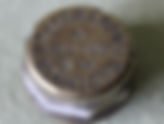
Wagon Wheel Nut BACK CLICK ON THE IMAGE TO SEE IN FULL Hayes and Son - Wagon Wheel Nut Hayes and Son were a very successful Carriage and Wagon makers whose main works and showroom was on Scotgate and the site is now a car park. Established in 1825, successive generations took the firm from being a wheelwright in Wansford to a business with factories in Stamford, Peterborough and London and from repairing farm wagons to the construction of carriages for the Prince of Wales, the King of Sweden and the Gaekwar of Baroda. The firm also made motor car bodies before the First World War, held Government Military Contracts and built one-offs like a Rhinoceros Wagon for Wombwell’s Menagerie. A disastrous fire in 1921 hastened the end of the company which ceased trading in 1924. DOWLOAD PDF Previous Next
- The Vestry Books and Registers of St.John's Parish, Stamford
< Back The Vestry Books and Registers of St.John's Parish, Stamford Submitted by Chris Hunt Perhaps the best plan to give an idea of the oldest of the three vestry books will be to take the first three pages, where are recorded the particulars of all the payments made by the Churchwardens for the year ending 18th April 1588, and a statement of the parish accounts rendered at the end of the year. The first entry reads this:- Payd forth for riting at the larst account to Master Tompson ijd. Payd uppon Low Sunday for a pynt of Moskadyne and brede vijd. for hallf a pynt the Sunday following iijd. for mending the grett bell stay ijd. for ij load of sand for the pavements xxid. for ijd load of stone carrige viijd. for mending an irron pin for the grett bell ijd. to the pavyer for his worke vis. viijd. to the plumer for mending the leaydes ijs. viijd. for wood id. the xxvijth of August for a quart of Moskadyne for the Communion xiid. to the bookbinder for mending the service book and the prayer book iis. vijd. to the parritor for the carriage of the inventary to Lincolln xiid. to George Ellington for harroing the Church land iiijs. for mending the bandrick of the seckond bell iiijd. Bestowed on the ringers on St. Thomas’ Day in drink and brede viiid. Payd for mending the grett bell whell iiijd. for neilles ijd. for a pottell of Moskadyne on Christmas Day for the Comunion ijs. for the xiiijth of January for a pynt of Moskadyne vid. for the xxith of January a pynt of Moskadyne for the Comunion vid. for mending the hookes of the Church door iiijd. for washing the surpllis and tabell clothe iiijd. for ij horses to the vysitation iis. viijd. for horse keep xd. for our dinners ijs. vid. for making our bill iiijd. for mending the belt of the grett bell and irons ijd. to Goodman Goodlands for mending the great whell and stay ijs. for a pottell of Moskadyne for Pallmes Sunday ijs. for glass for the west window and ij guardes viijd. for vi strick of barly for sede vis. xd. for George Ellington for pllowing and sowing iiijs. for half a pynt of Moskadyne for Easter even xijd. for V pientes of Moskadyne for Easter Daye ijs. vid. It is interesting to note the quantity of wine used at this period, viz., a pottel or four pints on Christmas Day and Palm Sunday; a quart was used on Easter Eve and five pints on Easter Day. These quantities are large, but I noticed in the account 40 years later, viz., in 1629, they were still larger, viz., on Good Friday two quarts and on Easter Day six quarts of wine were consumed. Other payments interesting to the parishioners of St. John’s are those referring to the cultivation of the church land, viz., for seed corn, ploughing, sowing and harrowing, as this land is still held by the Churchwardens though now let on a building lease and the rent used towards church expenses. After the detailed particulars of expenses the following memorandum is recorded, and it is interesting to notice the altered meaning of words. Memorandum that William Hutton and Matthew Southwell, Churchwardens of St. John’s Parish in Stamford, did gyve their accompt up to the viijth day of April 1588, for yo yeare before, before Tobye Loveday, Alderman of the Borough and Towne of Stamford aforesaid, Robert Meadowes, gentn; John Symon, John Yarwood, Geo. Hall, John Barnes, and others, in wch yeare their receipte came to xliiijs. ixd., and their allowance came to liiijs. ijd., so yt their allowance amounted their receipte ixs. ijd. All wch accompt was brought in Church stock, which at the accompt before was delivered to sundrie men as by the former accompt appeareth, and which Church stock with the increase comes zvl. xiijs. --- say Fyfteen pounds eyght shillings at which accompt the foresaid William Hutton, Senior Churchwarden, was dismyst, and John Musson was was elected the chosen officer by the parishioners, at which time was delivered to the Churchwarden the sum of eight and twenty shillings and sevenpence, and there remayned to be putt to trust of the Parish the summe of xiiil. xs., besyde xxxjs. for the two acres of barlye sold to John Barnes, to be payd at the next accompt, in the whole fyfteen pounds rwo shillings. I say xvl. ijs. Delivered the said thyrteen pounde tenn shillinge into the hande, custodye, and keping of Tobye Loveday, Alderman, and Robert Medowes, gentn. You will notice instead of their “payments exceeded their receipts,” it is stated “their allowance amounted their receipts,” and also that having fulfilled his duty and accounted for the balance in hand the senior Churchwarden was “dismyst,” really meaning they awarded him a legal discharge from further responsibility. In 1606 there is first entered a list of church goods which were formally handed over to the new Churchwarden, as follows:- A silver cuppe with a cover for the Comunion. An olde table clothe made of an olde cope. A surplis. A Bible in the large vollume. Two Comunion bookes. A prayer booke for the King’s deliverance. Jewell’s Appologie. Two bookes of Homelyes. One other little booke of Homelyes. Two bookes of Homelyes. One other little booke of Homelyes. A booke of Cannons. A Homelye on the right use of the Lord’s Supper. The Register books. In addition to the above, “A new bason” was given by one Anne Anthony in 1612, also two puter flagons and a boule for the Communion, given by Mr. Thomas Harrison of London, draper. In the list for 1634, is added:- A pewter cup for the bread. Four trenchers and a basket, and some additional books, viz:- An old book of prayers for Wednesday and Friday. A form of prayer with an order of Fasting. The remonstration of King James against Cardinal Perron and Erasmus’ Paraphrase of ye Four Evangelists and the Acts of the Apostles chained to a desk with two chains. The four trenchers seem to point to a practice, similar to that of the Scotch Church at the present time, of handling the bread to communicants in their seats. The Churchwardens appear to have regularly paid the ringers for ringing on the anniversary of the King’s Coronation, on the 5th November, St Thomas’ Day, for the Bishop, &c., and it was interesting to note in the accounts of 1634 an entry, “Paid for ringing when the King came through the town, 2/,” especially when referring to the history of Stamford, I found it recorded in May of that year “Charles the First and his Queen, after spending two days at Apethorpe, passed through Stamford, the Mayor bearing the mace before them.” The system of election of Churchwardens which ruled from 1588 to 1702 appears to be one which gave very many parishioners an interest in Parish work and might, I am inclined to think, be reverted to with advantage. Thus a senior Churchwarden, a junior Churchwarden and a sidesman being appointed, the next year the senior Churchwarden retired, the junior Churchwarden became the senior, and the sidesman became junior Churchwarden and a fresh parishioner was elected as sidesman. In 1702, however, the present rule of a Parish Churchwarden and a Rector’s Warden appears to have been introduced and the rotation system dropped. In 1608 a sounding board appears to have been thought necessary for both reading desk and pulpit, for there is an entry. Paid for making a new Reading seat and a cover over it and for the pulpit cover 48/2 The Vestry proceedings of 1626 are interesting to Stamfordians, as they may be seen the signatures of two comspicuous men, Mr Wm. Salter, who was three times Mayor, and also that of Mr Jeremy Cole, who was Mayor in 1640, when the Council petitioned Parliament in favour of making Stamford a shire town by adding to it the County of Rutland, the Soke of Peterborough and the Hundred of Vess. He also desired to make the river navigable and obtain other privileges. It appears to have been quite the practise at this period, 1630, to give the clergy occasionally officiating a complimentary present of wine, thus:- Gave to Mr. Fish, Preacher, a quart of white wine and sugar 1/6 Gave Mr. Williams a pint of sack 1/- Gave Mr. Millwood a pint of sack and a quart of claratt 2/- and not only the clergy but the Bishop also was favoured thus in 1633:- To the Bishop one pottell of sack 2/- and again in 1634:- Given the Bishop the 7 Aug. in wine 3/8 Another visitor in 1652 appears to have fared even better than the Bishop, it being recorded Sent M. How preaching at St. John’s a pint of sack and a pint of white wine, he dining at Mr. Alderman’s (that is at the mayor’s house. And at the end of the 17th century there are many entries such as the following:- 1673. Published and collected the brief for the great fire at Fordingbridge in Southamptonshire happening on Sunday, 23 June 1672, upon which was collected ten shillings and five pence. Again 1686:- Collected in the parish of St John’s £7 14s 4d for the poor distressed French Protestants. Briefs are mentioned very frequently but without the object being named. Archaeologists would be interested in the records of 1695 when Robert Peck, the father of Francis Peck, the antiquarian and historian, was elected sidesman, and in 1696 and 1697 junior and senior Churchwarden in the usual rotation previously mentioned. Francis Peck was born in the parish in 1692, the Register recording his baptism that year thus:- Francis son of Robert and Elizabeth Peck, born May 4th, bapd. May 12th. In the inventory of church goods in 1717 there is an additional item to those mentioned in1681. viz., a pulpit cloth, and I note this is as this same old pulpit cloth, more than 200 years old (with the date 1701 handsomely embroidered upon it) may still be seen at St. John’s Church, fixed up round the inside of the pulpit. Another difference in the two inventories is the omission in 1717 of “Twelve leather buckets” mentioned in an earlier list, at which time the church was apparently made use of as fire station. Under the date 16th April 1729, is an account of what certificate men belong to the parish, with a list of thirty names following, and a foot-note dated 26th April 1733:- An account of Ceificate men entered this day with 5 additional names. Later in the same month at a meeting, the Vestry marked their disapproval of supporting the “Bull Running” proceeding out of church funds, as it was resolved: That the Churchwardens shall not be allowed to expend money at the Apparitions, or on Bull Running Day or at any other time without the consent of the parish, and no allowance shall in future be made for ringing on 23rd April. This is St George’s Day, which used to be celebrated as a national festival long after and not withstanding Queen Elizabeth’s order to discontinue the celebration. I will only make one quotation from the last century’s records, namely in 1813. An agreement was made with Mr. Robert Taylor, of St. Neots, to re-hang the four bells and re-cast the second, for the sum of £42, carriage included. The Registers of St. John’s begin with the year 1561. The first records are from 1561 to 1634, written upon vellum. There is then a blank till 1664, from which date until 1705 they are continued. These two old registers were not put into bindings and were becoming very dilapidated. At my suggestion the then Churchwardens (Mr. Poole and the present Mayor, Mr Higgs) had then put into a suitable cover, which will protect them in future. The next volume dates from 1706 to 1774 and the third from 1775 to 1812. The first Register is headed thus:- All those that have been married, christened & bureyed from the first of St Michael the Archangel in the year of our Lord God 1561, unto the end & terme of the same feast in the year of our Lord God 1562. and the first entry is:- Married. Francis Tueson and Ellyn his wife 22 Oct. 1561. This is a name still known in Stamford, and, indeed, in St John’s Parish. Times do not appear to have been very prosperous in 1569 and 1570, as the record for both years reads:- Married this year – none. It is an interesting fact to the present Rector, and especially to the inmates of Snowden’s Hospital in Scotgate, that each page of the Register from 1561 to 1598 is signed by the Rector, Richard Snowden, the founder of that charity 300 years ago. Another memorial of this gentleman remains in in the church tower where one of the bells bears the inscription: “Richard Snowden, Parson, Anno, 1561”. The entry in 1585 of the burial on 2nd January of Richard Bernard, the Bellman, reminds us of the old custom of the Bellman, who used to go round the town between twelve at night and two in the morning for some weeks before Christmas, ringing his bell and informing the inhabitants of the time of night and the state of the weather. This custom was continued up to about 40 years ago (1860’s). The normal death rate of the parish for some years previous to 1604 had been about six or eight, but in that year when, as stated in Butcher’s History, 713 persons died of the plague in Stamford and St. Martin’s, a special entry of 88 burials is registered in St. John’s Register in six months, and included Mr Snowden, the Rector. The entry is headed:- In the sickness time from 27 April until 2 October 1604 were buried. then follow the names and dates, frequently two and three in a day, and whole families seem to have been stricken, for example:- Agnes Davison buried 17th June; Alice Davison buried 18th; Richard Davison buried 19th; Jane Davison buried 20th; Phillis Davison 21st. Again, the Norton family had a terrible record in the burial of seven members of the family in four days, viz.:- Zackary Norton, buried 5th Aug., Tobie Norton buried 6th Aug. & Lucy Norton the same day, Jane Norton on the 7th and Abraham Norton the same day, & Nicolas Norton & Lucy Norton, junr. on 8th August. The following is a copy of an entry made in the Register in 1602. Whereas there is a license to eat flesh upon fish days granted to Isabel Salter the wife of William Salter Gentleman, she being notoriously subject to sickness and with child, dated the 15th day of March 1602, and the cause thereof continuing still the eighth day after, and desiring the said licence to endure still upon full recovery, therefore the said license is recorded in the Church book the 8th day after the date thereof being the 22nd March in the year aforesaid in the presence of the Churchwardens. John Tod Thomas Lytler his mark. In 1633 the burial of the then Rector is recorded thus:- 2 July. Buried. John Reynolds Clark. and in the Churchwardens’ accounts is an entry Paid for ringing at the burial of Mr Reynolds 1/6 As this was more than the amount usually paid for ringing, viz., 8d., we may infer, I think, that dumb peal was rung on the occasion. In the Register of Baptisms for 1636 is that of Thomas Hardy, son of Thomas Hardy and Elizabeth his wife. This youth appears to have gone to London, as Thomas Hardy, citizen of London, died in 1747, founded the Charity now known as Hardy’s Charity, for the benefit of eight widows of St John’s, his native parish, and which is distributed on his birthday, 5th June. He was baptised on the 6th, the next day, as recorded in the Register. Stamford being situate upon the Great North Road accounts for many deaths being recorded of unknown travellers such as I find in 1769:- A poor unknown soldier buried 12 Sept. A poor traveller, his name not known 19 Sept. (Vestry Book 1675). The next is, I think, a very interesting entry referring to the burial of Humphrey, an ex-Churchwarden, Town Councillor, and a prominent parishioner. From the Vestry Book I find he was a Sidesman in 1647, Churchwarden in 1648, Overseer of the Poor in 1674. His name is frequently mentioned, and his signature appears as one of those present at the Vestry Meeting in 1675, yet in February 1680, when he died, in the place of the usual record of burial it is stated:- Humphrey Reynolds an excommunicate person thrown into a hole. This Humphrey Reynolds was a chandler and one of the issuers of the Stamford series of 17th century tokens. Drakard’s History of Stamford, page 529 gives an illustration of his coin. He took up his freedom 24th October, 1644, was elected a capital burgess 17th Feb., 1646, chamberlain 1656 (and therefore a predecessor of my own, as I am now chamberlain or borough treasurer), but he was removed from the chamber 7th October 1659, by virtue of a writ of mandamus. According to the sessions rolls he was pursuant to the verdict of the jury of the clerk of the market, fined 5/- for having four single pounds, two half-pounds, and two quarters too light, and on 5th April 1665, his name, with that of Humphrey Allen Reynolds, was presented to the jury, they having absented themselves from attending their parish church (St. John’s) for the space of three months. During his life he appears to have paid but little respect to either municipal or ecclesiastical authorities of the day, for besides being removed from the council chamber he was also excommunicated, as is proved by the record of his burial. Another reference to excommunication occurs two years later, when in 1682 is the following:- Mary the daughter of William Moss an excommunicate person was baptised & the mother churched. There are many records I could quote, interesting to Stamfordians of to-day, but I will only mention a few. 1751. Elizabeth daughter of Edward Lyon basket maker and Mary his wife. This name and trade is still associated together in Stamford. Mr W. Lyon of 36, Broad Street, is a basket maker, and I have no doubt this association has remained during the last 150 years. Another similar instance of a long succession in business occurs with the family of Ratcliffe, also basket makers. In 1770, Thomas, son of John and Elizabeth Ratcliffe, basket maker, was baptised, and up to a very few years ago Mr. Ratcliffe carried on the business now continued by Mr. Friend. Some of the occupations mentioned about this period are curious:- Humphrey Jenkins, wire dancer. John Johnson, silk throster. J.Skeith, dish turner. Sam Tabbener, horse courser. Geo. Allen, post boy. Israel Holford, hemp dresser. In 1769 is recorded the burial of Cassandra wife of James Whitley, player, aged 57. Buried 10th Feb. I mention this as there is a monumental tablet on the north wall of St John’s Church to the memory of this lady, described as one “who possessed all the good qualities that accomplish the best of women,” and judging by the monument, the shield of arms and crest, and the description of the husband as James Whitley, Gentleman, he was probably a man of means and a noted actor in his day, who had retired and settled in Stamford. It will be interesting to members of the Stamford and County Club in St Mary’s Street to know that this James Whitley it was, who with Mr. Alderman Clarke, built the old Stamford Theatre in 1768, at a cost of over £800, and which building was converted into the present Club Room in 1871. After 1754 a separate Register was kept for marriages, and first used in August of that year, according to Act of Parliament. Whereas previously there was only the entry in the handwriting of the Registrar, in the new book both the contracting parties sign in the presence of two witnesses and the officiating clergyman as at present. It is interesting to note that the first 50 marriages there are 54 signatures and 46 marks, so that only about half the persons were able to write their names. The marks, however, are very interesting, not being ordinary crosses, but a printed initial P or T, a man’s hat, fish-hook, half-circle, a square and many other things. I will only give one more extract and that is for the year 1783, when on March 30th is recorded the burial of Wm. Pepper, victualler, aged 49, who, according to Drakard’s History, aspired to be a poet. Upon his grave stone in St. John’s Churchyard was inscribed, after the usual name and date:- Tho’ hot my name, yet mild my nature, I bore good will to every creature, I brewed fine ale and sold it too, And unto each I gave his due. THOMAS SANDALL (1905) SOURCE THE RUTLAND MAGAZINE VOL. 2 No. 12 – 1905-06 page 117-124 for the xiiijth of January for a pynt of Moskadyne vid. for the xxith of January a pynt of Moskadyne for the Comunion vid. for mending the hookes of the Church door iiijd. for washing the surpllis and tabell clothe iiijd. for ij horses to the vysitation iis. viijd. for horse keep xd. for our dinners ijs. vid. for making our bill iiijd. for mending the belt of the grett bell and irons ijd. to Goodman Goodlands for mending the great whell and stay ijs. for a pottell of Moskadyne for Pallmes Sunday ijs. for glass for the west window and ij guardes viijd. for vi strick of barly for sede vis. xd. for George Ellington for pllowing and sowing iiijs. for half a pynt of Moskadyne for Easter even xijd. for V pientes of Moskadyne for Easter Daye ijs. vid. It is interesting to note the quantity of wine used at this period, viz., a pottel or four pints on Christmas Day and Palm Sunday; a quart was used on Easter Eve and five pints on Easter Day. These quantities are large, but I noticed in the account 40 years later, viz., in 1629, they were still larger, viz., on Good Friday two quarts and on Easter Day six quarts of wine were consumed. Other payments interesting to the parishioners of St. John’s are those referring to the cultivation of the church land, viz., for seed corn, ploughing, sowing and harrowing, as this land is still held by the Churchwardens though now let on a building lease and the rent used towards church expenses. After the detailed particulars of expenses the following memorandum is recorded, and it is interesting to notice the altered meaning of words. Memorandum that William Hutton and Matthew Southwell, Churchwardens of St. John’s Parish in Stamford, did gyve their accompt up to the viijth day of April 1588, for yo yeare before, before Tobye Loveday, Alderman of the Borough and Towne of Stamford aforesaid, Robert Meadowes, gentn; John Symon, John Yarwood, Geo. Hall, John Barnes, and others, in wch yeare their receipte came to xliiijs. ixd., and their allowance came to liiijs. ijd., so yt their allowance amounted their receipte ixs. ijd. All wch accompt was brought in Church stock, which at the accompt before was delivered to sundrie men as by the former accompt appeareth, and which Church stock with the increase comes zvl. xiijs. --- say Fyfteen pounds eyght shillings at which accompt the foresaid William Hutton, Senior Churchwarden, was dismyst, and John Musson was was elected the chosen officer by the parishioners, at which time was delivered to the Churchwarden the sum of eight and twenty shillings and sevenpence, and there remayned to be putt to trust of the Parish the summe of xiiil. xs., besyde xxxjs. for the two acres of barlye sold to John Barnes, to be payd at the next accompt, in the whole fyfteen pounds rwo shillings. I say xvl. ijs. Delivered the said thyrteen pounde tenn shillinge into the hande, custodye, and keping of Tobye Loveday, Alderman, and Robert Medowes, gentn. You will notice instead of their “payments exceeded their receipts,” it is stated “their allowance amounted their receipts,” and also that having fulfilled his duty and accounted for the balance in hand the senior Churchwarden was “dismyst,” really meaning they awarded him a legal discharge from further responsibility. In 1606 there is first entered a list of church goods which were formally handed over to the new Churchwarden, as follows:- A silver cuppe with a cover for the Comunion. An olde table clothe made of an olde cope. A surplis. A Bible in the large vollume. Two Comunion bookes. A prayer booke for the King’s deliverance. Jewell’s Appologie. Two bookes of Homelyes. One other little booke of Homelyes. Two bookes of Homelyes. One other little booke of Homelyes. A booke of Cannons. A Homelye on the right use of the Lord’s Supper. The Register books. In addition to the above, “A new bason” was given by one Anne Anthony in 1612, also two puter flagons and a boule for the Communion, given by Mr. Thomas Harrison of London, draper. In the list for 1634, is added:- A pewter cup for the bread. Four trenchers and a basket, and some additional books, viz:- An old book of prayers for Wednesday and Friday. A form of prayer with an order of Fasting. The remonstration of King James against Cardinal Perron and Erasmus’ Paraphrase of ye Four Evangelists and the Acts of the Apostles chained to a desk with two chains. The four trenchers seem to point to a practice, similar to that of the Scotch Church at the present time, of handling the bread to communicants in their seats. The Churchwardens appear to have regularly paid the ringers for ringing on the anniversary of the King’s Coronation, on the 5th November, St Thomas’ Day, for the Bishop, &c., and it was interesting to note in the accounts of 1634 an entry, “Paid for ringing when the King came through the town, 2/,” especially when referring to the history of Stamford, I found it recorded in May of that year “Charles the First and his Queen, after spending two days at Apethorpe, passed through Stamford, the Mayor bearing the mace before them.” The system of election of Churchwardens which ruled from 1588 to 1702 appears to be one which gave very many parishioners an interest in Parish work and might, I am inclined to think, be reverted to with advantage. Thus a senior Churchwarden, a junior Churchwarden and a sidesman being appointed, the next year the senior Churchwarden retired, the junior Churchwarden became the senior, and the sidesman became junior Churchwarden and a fresh parishioner was elected as sidesman. In 1702, however, the present rule of a Parish Churchwarden and a Rector’s Warden appears to have been introduced and the rotation system dropped. In 1608 a sounding board appears to have been thought necessary for both reading desk and pulpit, for there is an entry. Paid for making a new Reading seat and a cover over it and for the pulpit cover 48/2 The Vestry proceedings of 1626 are interesting to Stamfordians, as they may be seen the signatures of two comspicuous men, Mr Wm. Salter, who was three times Mayor, and also that of Mr Jeremy Cole, who was Mayor in 1640, when the Council petitioned Parliament in favour of making Stamford a shire town by adding to it the County of Rutland, the Soke of Peterborough and the Hundred of Vess. He also desired to make the river navigable and obtain other privileges. It appears to have been quite the practise at this period, 1630, to give the clergy occasionally officiating a complimentary present of wine, thus:- Gave to Mr. Fish, Preacher, a quart of white wine and sugar 1/6 Gave Mr. Williams a pint of sack 1/- Gave Mr. Millwood a pint of sack and a quart of claratt 2/- and not only the clergy but the Bishop also was favoured thus in 1633:- To the Bishop one pottell of sack 2/- and again in 1634:- Given the Bishop the 7 Aug. in wine 3/8 Another visitor in 1652 appears to have fared even better than the Bishop, it being recorded Sent M. How preaching at St. John’s a pint of sack and a pint of white wine, he dining at Mr. Alderman’s (that is at the mayor’s house. And at the end of the 17th century there are many entries such as the following:- 1673. Published and collected the brief for the great fire at Fordingbridge in Southamptonshire happening on Sunday, 23 June 1672, upon which was collected ten shillings and five pence. Again 1686:- Collected in the parish of St John’s £7 14s 4d for the poor distressed French Protestants. Briefs are mentioned very frequently but without the object being named. Archaeologists would be interested in the records of 1695 when Robert Peck, the father of Francis Peck, the antiquarian and historian, was elected sidesman, and in 1696 and 1697 junior and senior Churchwarden in the usual rotation previously mentioned. Francis Peck was born in the parish in 1692, the Register recording his baptism that year thus:- Francis son of Robert and Elizabeth Peck, born May 4th, bapd. May 12th. In the inventory of church goods in 1717 there is an additional item to those mentioned in1681. viz., a pulpit cloth, and I note this is as this same old pulpit cloth, more than 200 years old (with the date 1701 handsomely embroidered upon it) may still be seen at St. John’s Church, fixed up round the inside of the pulpit. Another difference in the two inventories is the omission in 1717 of “Twelve leather buckets” mentioned in an earlier list, at which time the church was apparently made use of as fire station. Under the date 16th April 1729, is an account of what certificate men belong to the parish, with a list of thirty names following, and a foot-note dated 26th April 1733:- An account of Ceificate men entered this day with 5 additional names. Later in the same month at a meeting, the Vestry marked their disapproval of supporting the “Bull Running” proceeding out of church funds, as it was resolved: That the Churchwardens shall not be allowed to expend money at the Apparitions, or on Bull Running Day or at any other time without the consent of the parish, and no allowance shall in future be made for ringing on 23rd April. This is St George’s Day, which used to be celebrated as a national festival long after and not withstanding Queen Elizabeth’s order to discontinue the celebration. I will only make one quotation from the last century’s records, namely in 1813. An agreement was made with Mr. Robert Taylor, of St. Neots, to re-hang the four bells and re-cast the second, for the sum of £42, carriage included. The Registers of St. John’s begin with the year 1561. The first records are from 1561 to 1634, written upon vellum. There is then a blank till 1664, from which date until 1705 they are continued. These two old registers were not put into bindings and were becoming very dilapidated. At my suggestion the then Churchwardens (Mr. Poole and the present Mayor, Mr Higgs) had then put into a suitable cover, which will protect them in future. The next volume dates from 1706 to 1774 and the third from 1775 to 1812. The first Register is headed thus:- All those that have been married, christened & bureyed from the first of St Michael the Archangel in the year of our Lord God 1561, unto the end & terme of the same feast in the year of our Lord God 1562. and the first entry is:- Married. Francis Tueson and Ellyn his wife 22 Oct. 1561. This is a name still known in Stamford, and, indeed, in St John’s Parish. Times do not appear to have been very prosperous in 1569 and 1570, as the record for both years reads:- Married this year – none. It is an interesting fact to the present Rector, and especially to the inmates of Snowden’s Hospital in Scotgate, that each page of the Register from 1561 to 1598 is signed by the Rector, Richard Snowden, the founder of that charity 300 years ago. Another memorial of this gentleman remains in in the church tower where one of the bells bears the inscription: “Richard Snowden, Parson, Anno, 1561”. The entry in 1585 of the burial on 2nd January of Richard Bernard, the Bellman, reminds us of the old custom of the Bellman, who used to go round the town between twelve at night and two in the morning for some weeks before Christmas, ringing his bell and informing the inhabitants of the time of night and the state of the weather. This custom was continued up to about 40 years ago (1860’s). The normal death rate of the parish for some years previous to 1604 had been about six or eight, but in that year when, as stated in Butcher’s History, 713 persons died of the plague in Stamford and St. Martin’s, a special entry of 88 burials is registered in St. John’s Register in six months, and included Mr Snowden, the Rector. The entry is headed:- In the sickness time from 27 April until 2 October 1604 were buried. then follow the names and dates, frequently two and three in a day, and whole families seem to have been stricken, for example:- Agnes Davison buried 17th June; Alice Davison buried 18th; Richard Davison buried 19th; Jane Davison buried 20th; Phillis Davison 21st. Again, the Norton family had a terrible record in the burial of seven members of the family in four days, viz.:- Zackary Norton, buried 5th Aug., Tobie Norton buried 6th Aug. & Lucy Norton the same day, Jane Norton on the 7th and Abraham Norton the same day, & Nicolas Norton & Lucy Norton, junr. on 8th August. The following is a copy of an entry made in the Register in 1602. Whereas there is a license to eat flesh upon fish days granted to Isabel Salter the wife of William Salter Gentleman, she being notoriously subject to sickness and with child, dated the 15th day of March 1602, and the cause thereof continuing still the eighth day after, and desiring the said licence to endure still upon full recovery, therefore the said license is recorded in the Church book the 8th day after the date thereof being the 22nd March in the year aforesaid in the presence of the Churchwardens. John Tod Thomas Lytler his mark. In 1633 the burial of the then Rector is recorded thus:- 2 July. Buried. John Reynolds Clark. and in the Churchwardens’ accounts is an entry Paid for ringing at the burial of Mr Reynolds 1/6 As this was more than the amount usually paid for ringing, viz., 8d., we may infer, I think, that dumb peal was rung on the occasion. In the Register of Baptisms for 1636 is that of Thomas Hardy, son of Thomas Hardy and Elizabeth his wife. This youth appears to have gone to London, as Thomas Hardy, citizen of London, died in 1747, founded the Charity now known as Hardy’s Charity, for the benefit of eight widows of St John’s, his native parish, and which is distributed on his birthday, 5th June. He was baptised on the 6th, the next day, as recorded in the Register. Stamford being situate upon the Great North Road accounts for many deaths being recorded of unknown travellers such as I find in 1769:- A poor unknown soldier buried 12 Sept. A poor traveller, his name not known 19 Sept. (Vestry Book 1675). The next is, I think, a very interesting entry referring to the burial of Humphrey, an ex-Churchwarden, Town Councillor, and a prominent parishioner. From the Vestry Book I find he was a Sidesman in 1647, Churchwarden in 1648, Overseer of the Poor in 1674. His name is frequently mentioned, and his signature appears as one of those present at the Vestry Meeting in 1675, yet in February 1680, when he died, in the place of the usual record of burial it is stated:- Humphrey Reynolds an excommunicate person thrown into a hole. This Humphrey Reynolds was a chandler and one of the issuers of the Stamford series of 17th century tokens. Drakard’s History of Stamford, page 529 gives an illustration of his coin. He took up his freedom 24th October, 1644, was elected a capital burgess 17th Feb., 1646, chamberlain 1656 (and therefore a predecessor of my own, as I am now chamberlain or borough treasurer), but he was removed from the chamber 7th October 1659, by virtue of a writ of mandamus. According to the sessions rolls he was pursuant to the verdict of the jury of the clerk of the market, fined 5/- for having four single pounds, two half-pounds, and two quarters too light, and on 5th April 1665, his name, with that of Humphrey Allen Reynolds, was presented to the jury, they having absented themselves from attending their parish church (St. John’s) for the space of three months. During his life he appears to have paid but little respect to either municipal or ecclesiastical authorities of the day, for besides being removed from the council chamber he was also excommunicated, as is proved by the record of his burial. Another reference to excommunication occurs two years later, when in 1682 is the following:- Mary the daughter of William Moss an excommunicate person was baptised & the mother churched. There are many records I could quote, interesting to Stamfordians of to-day, but I will only mention a few. 1751. Elizabeth daughter of Edward Lyon basket maker and Mary his wife. This name and trade is still associated together in Stamford. Mr W. Lyon of 36, Broad Street, is a basket maker, and I have no doubt this association has remained during the last 150 years. Another similar instance of a long succession in business occurs with the family of Ratcliffe, also basket makers. In 1770, Thomas, son of John and Elizabeth Ratcliffe, basket maker, was baptised, and up to a very few years ago Mr. Ratcliffe carried on the business now continued by Mr. Friend. Some of the occupations mentioned about this period are curious:- Humphrey Jenkins, wire dancer. John Johnson, silk throster. J.Skeith, dish turner. Sam Tabbener, horse courser. Geo. Allen, post boy. Israel Holford, hemp dresser. In 1769 is recorded the burial of Cassandra wife of James Whitley, player, aged 57. Buried 10th Feb. I mention this as there is a monumental tablet on the north wall of St John’s Church to the memory of this lady, described as one “who possessed all the good qualities that accomplish the best of women,” and judging by the monument, the shield of arms and crest, and the description of the husband as James Whitley, Gentleman, he was probably a man of means and a noted actor in his day, who had retired and settled in Stamford. It will be interesting to members of the Stamford and County Club in St Mary’s Street to know that this James Whitley it was, who with Mr. Alderman Clarke, built the old Stamford Theatre in 1768, at a cost of over £800, and which building was converted into the present Club Room in 1871. After 1754 a separate Register was kept for marriages, and first used in August of that year, according to Act of Parliament. Whereas previously there was only the entry in the handwriting of the Registrar, in the new book both the contracting parties sign in the presence of two witnesses and the officiating clergyman as at present. It is interesting to note that the first 50 marriages there are 54 signatures and 46 marks, so that only about half the persons were able to write their names. The marks, however, are very interesting, not being ordinary crosses, but a printed initial P or T, a man’s hat, fish-hook, half-circle, a square and many other things. I will only give one more extract and that is for the year 1783, when on March 30th is recorded the burial of Wm. Pepper, victualler, aged 49, who, according to Drakard’s History, aspired to be a poet. Upon his grave stone in St. John’s Churchyard was inscribed, after the usual name and date:- Tho’ hot my name, yet mild my nature, I bore good will to every creature, I brewed fine ale and sold it too, And unto each I gave his due. THOMAS SANDALL (1905) SOURCE THE RUTLAND MAGAZINE VOL. 2 No. 12 – 1905-06 page 117-124 A printed version HERE Previous Next
- St John's Parish Stamford Owning Land in Ufford 1860
< Back St John's Parish Stamford Owning Land in Ufford 1860 By Chris Hunt The parish of St. John, Stamford, has a small portion of land lying in Ufford, Southorpe and Newbery fields, the yearly rental of which, formerly amounting to £6 0s 0d, has been distributed on St Thomas’s day (December 21st) to the poor ratepayers. This year there will be for distribution £12 19s 0d, which Mr. Hayes, the occupier, has been paid into the hands of Mr. Walker, one of the overseers. The advanced rental was obtained during the overseership of Messrs. J.Ford and H.Moore by re-letting the land by auction; so that the poor of St John’s will have a greater gift distributed amongst them this year than in any previous year from the same source. Source Stamford Mercury Friday December 14th 1860 p4/c2 A print version can be downloaded HERE Previous Next
- Stamford Poor Law Union
a history of Stamford's workhouse < Back Stamford Poor Law Union Dr Stella Henriques 1979 This article was written by the late Dr Stella Henriques, and first published in the Stamford Historian in February 1979. As a source for the article, Dr Henriques made extensive use of the files of the Stamford Mercury, which at that time were little used by local historians. In a brief introduction, Mr William Kirkwood puts the Stamford workhouse into context. The workhouse described here lasted some 65 years until, in 1899, the Guardians took the decision to build a new workhouse on the Bourne Road (now Ryhall Road); this new building was completed in 1902 and accommodated 175 inmates. After 1930 the new workhouse became a Public Assistance Institution and in 1948 became part of the new National Health Service as St. George’s Hospital. The building was demolished some years ago to make way for retirement housing. Introduction By 1836, when the building of the St. Martin’s workhouse was started, Stamford had known almost a hundred years of experience with town workhouses. During that time there had been two successive houses, one in St. George’s parish and the other in St. Michael’s parish, both of them shared by most or all of the parishes on the town. But a new house was needed after the 1834 Poor Law Amendment Act which created a new Stamford Union with a total of 37 parishes covering a large area of Rutland, Northamptonshire, the soke of Peterborough, Kesteven and even parts of Huntingdonshire. With such a large area after 1834, any comparison of figures from before the Amendment Act would be valueless. Yet it is important to remember that the town workhouse before 1834 also served a wider area than just the parish in which it stood. However, it was clearly much too small to serve the area of the new Poor Law Union and thus another one had to be built. The Poor Law Amendment Act had two other main results. It made Stamford for the first (and incidentally for the last) time the administrative centre of a region; and it strengthened the position of the Marquess of Exeter, whose estate it covered and who came to hold the position of Chairman of the Board of Guardians. This last fact does not necessarily however, explain the siting of the new workhouse. Most of Stamford’s land was as yet unenclosed, which made it difficult to find building land; so that the offer of the Marquess of a suitable site in St Martin’s parish would seem to have been an act of generosity. Not long after the period described below, the workhouse was rebuilt once more in St George’s parish, this time on the Ryhall Road. The present building is the second one on that site, having been erected in the twentieth century. 1836-1837 On January 20th 1836, the Marquess of Exeter laid before the new Stamford Union Board of Guardians a plan and estimate for a workhouse to contain 300 paupers. The buildings were to cover ‘2 rood and 10 perches of land and their expense was estimated by Mr Browning (the architect) at £3,880.’ Lord Exeter offered to sell for the purpose a piece of land on the north side of the road leading from St Martin’s to Pilsgate. Some people didn’t approve of this site as they considered it to be ‘low, damp and unhealthy, being in the neighbourhood of the river, and adjacent to meadows subject to being flooded’, and a Building Committee was appointed to investigate the whole subject of site and plan of the building. However, the committee decided that the new workhouse should be built on the site offered subject to some alterations to the plan, and when these were done it was adopted on the understanding that the alterations would increase the expense by £100. The house was to contain six wards: one for 40 able-bodied men, one for 40 able-bodied females, one for 51 infirm men, one for 51 infirm females, one for 60 boys and another for 60 girls. The Marquess accepted the proposed terms of £100 per acre. The plans were sent to the Board of Commissioners in London for approval and an application was made for a loan of £4,800 for building the workhouse, to be repaid in ten annual instalments of £480 each. Tenders for building the workhouse were now received, and that of Mr. Pilkington was accepted at a price of £3,645, exclusive of the charge for a wall to surround the whole premises which would cost £500 more. It was feared that there would be extra expense for the foundations ‘as the site is that of an exhausted stone pit’. In fact the site was questioned in mid-March when the contractor stated that to make the foundation on that spot would cost £900 more than had been allowed for in the estimate, and feelings ran high. The Marquess was entreated to consent to abandon the site but he refused to do so and in April, Mr Pilkington was told to fulfil his contract, the time for completing it being extended to the 25th March 1837 ‘in consideration of the time (as well as money) lost in the foundations.’ The vicar of St Martin’s complained that there would be an increase of clerical duties as the workhouse would be in his parish, so a Chaplain had to be appointed; also there was a necessity of providing a burial ground for the use of the Union. The loan of £4,000 was granted at 4% per annum and a petition was forwarded that the period for repayment be extended to 20 years. Fire insurance was to be borne at the joint expense of the Union and the contractor. In September, the corn-mill and dressing machine which had been ordered arrived from Birmingham; these were now put up so that there might be employment for such able-bodied men who might be admitted. The request by the Chaplain to the workhouse ‘that a surplice be found for him’ in addition to his £25 a year was ignored by common consent. Previously, the Board had met in the Town Hall, but on 5th May 1837, the Guardians met for the first time in the Board-room of the new workhouse, and a few days later, 17 men, 13 women, 22 children and two lunatics (sex unknown) had arrived from the earlier town poorhouse. 1850 In January 1850 there were 250 inmates, 49 more than the previous year at the same time; 917 persons were recipients of out-door relief as against 813 in 1849, and the cost of weekly maintenance was now £79. 8s. 0d as against £76. 5s. 5d in 1849. The following month, numbers were diminishing as far as able-bodied men were concerned as ‘work in the field was about to commence.’ On March 13th, the Inspector of Union schools made a favourable report on the industrial training of the children. It was also ordered that the inmates of the Union house should have two half-day holidays to visit Stamford mid-Lent fair and that the children should have a gratuity of 1d piece on each day. There were 165 paupers in the house, 35 less than at the same time in 1849. Contracts for supplies consisted of bread (2nds), per 4lb loaf, 3 ¾d; flour, per stone, 1/7d; Scotch oatmeal per 32 lbs, 4/6d; beef and mutton per stone 5/3d; black tea per lb 3/4d; Jamaica sugar, per lb 4d; Leicestershire cheese per lb. 6d; Patna rice per lb. 2d; salt per cwt 1/9d; yellow soap per cwt. £2. 2s. 0d; store candles per doz. 4/9d; butter (Dutch) per lb 9d; soda per cwt. 8/-; and hard pit coal, per ton 12/8d. It was interesting to note that by 1870 there were some changes and additions. The 4lb loaf was 4 ½d; beef and mutton had become separated and beef without bone per stone was 8/11d; mutton per stone 7/11d; suet (beef and mutton) per stone 6/9d; loaf sugar per lb 5d; peas (split) per bushel 7/6d; butter (salt) per lb 1/- or fresh per lb 1/4d; tallow soap (mottled) per cwt. £1.15.6; tallow soap (yellow) per cwt. £1.10.0. In March 1850 the Schoolmaster and Schoolmistress made an application for an increased allowance of rations on the grounds that the rations were more liberal for similar persons in the Unions of Bourne, Spalding and Sleaford, but as it was stated that the Stamford salaries were higher than in the other places the application was left ‘undetermined’. In April the Mercury reported that ‘In the face of much zealous prophecy to the contrary, the lower classes in this part of the country are happily better off than they had been for a long period. The complaints of deficiency of work are comparatively few, and able-bodied men find employment at a fair rate of wages. The Great Eastern Railway works at Peterborough afford labour to very many hands, and we hear that the Marquis of Exeter employs more than a hundred persons in some agricultural improvements he is effecting at King’s Cliffe.’ There were fewer inmates and the number of casual paupers nil; there had been 131 at the same time in the previous year. The Mercury concludes ‘Whatever may be the cause of this decrease of pauperism, the fact is gratifying in a moral and social point of view, and it will of course prove beneficial to the rate payers.’ In May, the returns continued to show a fall in the numbers: 143 inmates compared with 156 in 1849. Admission of casual paupers was three against 79 in May 1949. ‘It is believed the Bath Test is the principal agent which deters the application of vagrants. Not one in 100 will submit to a thorough washing.’ The following month the figures were even lower. The Government Inspector of Schools visited the Union-house in September and in the Visitors’ Book remarked that he found the state of education very satisfactory but there was ‘room for improvement in the spelling of the lower classes.’ Contracts were entered into for supplying shoes and drapery. By November, applications for outdoor relief were increasing – mainly for the infirm, widows and children. It was hoped that the start of works near Lynn on the Norfolk and Lincolnshire Estuary would give employment throughout the winter to labourers who couldn’t find jobs nearer home. At the December meeting of the Guardians, the Medical Officer complained that two of the sick inmates had greatly abused him, and that one of them had seized a poker and advanced towards him in a ‘threatening attitude.’ The second man had refused to take his medicine and said that he wasn’t being properly treated. However, the doctor was able to prove that this was not the case and the man was reprimanded. When the first patient was summoned to be sent before the Magistrates, it was found that he had discharged himself and left the premises. For Christmas Day, the Guardians subscribed among themselves and provided ‘festal fare’. Each man, woman and child was regaled with roast beef, plum pudding and ale, to the complete satisfaction of all. 32 able-bodied and 30 aged men, 42 able-bodied and 7 aged women, 42 boys and 41 girls and 11 infants. 1870 In January 1870, a man who came to Stamford as a confectioner was taken ill and complained that he had been kept in the Vagrant ward for two months. One of the Guardians (Dr Hopkinson) said that it wasn’t a proper place for a person suffering from disease and the Medical Officer was asked for an explanation. One cannot help feeling that the Medical Officer enjoyed giving it, for in his statement ‘he described the nature of the disease under which the man was suffering, and said that the infirmary of the Union-house was so full that the patient was really better in the tramp-ward than in the infirmary, the area of the latter not affording the proper number of cubic feet of air for those sent there’. He also referred to a minute made by him as far back as 10th June 1868, in which he pointed out the necessity of appropriating the fever hospital as an infirmary and using the infirmary as an infirm ward, and that a qualified nurse ought to be engaged by the Guardians. The Guardians agreed to the engagement of a nurse and Mr Heward (the M.O.) followed this up by asking for a small room in the house for a surgery ‘where he might see some of the patients and dispense medicine, and that a medicine chest with medicine be furnished by the Guardians his remuneration as a Medical Officer of the house being insufficient, taking into account the number of patients and the quantity of medicine required.’ This was discussed the following month. One of the Board members complained that at the Stamford and Rutland Infirmary the cost of medicine and instruments came to 4/6d per patient and of that 3/6d was spent on drugs, and that in a large dispensary in Berkshire, it was only 1/9d per patient. It was explained that in a district where low fevers and ague prevailed as in Lincolnshire, more costly medicine was used. So it was decided that the M.O. should have a room set aside for a surgery, his salary should be raised from £25 to £35 per annum and Cod liver oil and Quinine should be paid for extra as usual. Some weeks later a nurse for the infirmary was appointed. The severity of the weather in February brought about an increase in the number of able-bodied men seeking relief. In cases of families, bread was given, but in the main admission to the house was offered. A Poor-Law Inspector who was leaving the district reported that the receiving wards required to be whitewashed and properly furnished; the vagrant wards were in a dilapidated state and required more light and ventilation; the children’s day rooms and schoolrooms should have ‘boarden’ instead of stone floors; and the house generally required to be painted and whitewashed. When these recommendations were considered, the boarding of the schoolroom floors was resisted on the ground that they would need to be washed frequently and as they took a long time drying, there would be a greater risk than at present in the children catching cold. A notice containing a list of women, girls and boys requiring situations was affixed outside the Union-house gate. In April, an extremely heated discussion took place on the meaning of the term ‘destitution’. This arose from the case of a woman who had applied for relief. She was a widow with two children and lived in a house of £8. She had been helped in paying this by her uncle who had died. She had managed to keep herself by using her savings and small earnings for three years, but could do so no longer. It was contended against her claim for relief that while she had furniture, she could not be considered destitute. The Board agreed that in justice to the Ratepayers she must be refused relief; but in opposition it was remarked that the Board should be considered Guardians of the poor as well as the ratepayers, and that having so long tried to keep her family without troubling the Union, she should not be compelled to sell her household goods before she could claim relief. The application was refused by five votes to four. The number of inmates was and had been higher for some months than at the same period in the previous year, e.g. May 6th 1870, 203; 1869, 169; Outdoor relief was however less; 1870, 799 (£89. 19. 3) and 1869, 818 (£108. 3. 5). Seventy four vagrants were admitted. At the latter part of May, a large number of wives of Militia men applied for relief, their husbands being at Grantham for training, and allowances were made. The severe winter had been followed by a prolonged drought and in June many able-bodied men were out of work and applied for relief. The drought lasted for nearly three months with no ‘sensible amount of rain except for one day’. However, later some work was found in Southorpe woods, the steward of the estate having started grubbing operations earlier than intended so that the pressure of able-bodied applicants was somewhat diminished. A brick-maker from Bourne was summoned to appear to explain why he had not contributed to the support of his father who had been an inmate for some years; other sons were also summoned and the brick-maker was ordered (on order from Bourne Sessions) to pay 2/- per week for his father’s support. Later the father left the house. July 19th. The applications for relief were fewer but the number in the house continued in excess of the average – 185 as against 146 the year before and 60 vagrants. It was noted that one batch of bread was ‘very heavy’. On July 22nd the Marquess of Exeter gave permission for the Union School children to have a picnic in Burghley Park and sent £6 to be expended on small presents for the party. The 84 children were given tea, cake, fruit and a number of swings and other amusements were provided. Each child was given a basket of fruit. August. The new Poor Law Inspector reported that he was satisfied to find ‘that certain suggestions made by his predecessor had been carried out and that all the inmates of whom he had made enquiry admitted that they were kindly treated’. He also suggested, among other things, that there should be a fence in front of the infirmary to ‘keep the patients from the paupers who work or walk in the garden’. And that the receiving wards should be ventilated. It was agreed by the Board that the contract for meat next quarter should be beef and mutton separately, and not in aggregate, and that henceforward the inmates should have mutton twice a week and beef on Sundays. The relieving officer was asked to prepare a list of aged recipients of out-relief who would prefer to be paid entirely in money instead of money and bread. The intention to enclose the front of the infirmary with a ha-ha fence was recommended and the labour for such could be found in the house. As the autumn approached so did unemployment increase and also applicants for relief, many of whom had come from long distances in search of work. In October as there was a large number of old and some able-bodied men in the house without work, it was decided that they set to oakum picking. The cost of the material was 13/- per cwt and when picked was worth 20/-, so it was agreed to buy a ¼ of a ton of junk, inmates to pick 3lbs per day and tramps 1lb. December. The Central Board issued an order on the boarding out of pauper children. Previously children could not be placed in homes beyond the limit of their own Union. However the Guardians were now empowered to do so. The order recommended that there should be no boarding with out-door paupers; that, in the foster parents open air should be preferred to sedentary labour, that special attention should be paid to decent accommodation and the proper separation of the sexes; that great care should be taken to provide children with education and with clothing; and that all boarding out in large towns to be avoided. Christmas was now approaching and the usual Christmas dinner for the inmates was voted and it was also determined to give an extra shilling to families on out relief. The dinner was to be given on the 26th as Christmas Day fell on a Sunday. Before this, the inmates had a dinner of roast beef and plum pudding on the 20th to celebrate the coming of age of Lord Burghley. The Marquess sent £10 to be spent on articles for the women and children. There was also a Christmas tree for the children but that was reserved for the 26th. It was unfortunate that ‘owing to bad cooking’ the Christmas dinner for the 207 inmates was not enjoyed as much as usual. The number of inmates on December 30th 1869 and 1870 were as follows: 1870 1869 Inmates 207 215 Out-relief 797 856 A print version can be downloaded HERE Previous Next
- Stamford Improvement Commission Meeting. Foul Smells in Stamford 1854
< Back Stamford Improvement Commission Meeting. Foul Smells in Stamford 1854 Submitted by Chris Hunt Mr English pointed out the great necessity that existed for an inspection of nuisances in the town. Fever was prevalent in some parts, and noxious smells from pigsties and cesspools had a tendency to increase the epidemic. He did not exactly know upon which public body the burden lay for correcting the evil, but it must be apparent to everyone that with fever in the town and cholera in the country, the utmost precaution should be taken to ensure general cleanliness. Mr. Paradise said he was glad the subject had been mentioned, for though the duty pointed out properly came under the direction of the Poor-law Guardians, it could not be too strongly urged before each local Board. There were some places in the town so exceedingly offensive that it was not at all surprising to hear of the prevalence of fever; and those who knew the value to a community of sanitary precautions could not interfere too actively to procure the abatement of nuisances. Mr Horden and the Chairman said it was very desirable that an inspector should be appointed at the present critical time ’ and the Clerk having explained that the duty of instructing and paying an inspector was by the Legislature imposed on the Poor-law Board, it was agreed by several Guardians present to introduce the subject at the Union meeting on the following day. SOURCE STAMFORD MERCURY (FRIDAY) SEPTEMBER 1ST 1854 p3/c2 Note Stamford was not a genteel town with modern Victorian infrastructure in 1854 and was still restricted in its growth by the then Marquess of Exeter. The above report comes from a meeting of the Stamford Improvement Commission held on August 29th 1854. The commissioners present on the day were Messrs. Fysh (chairman), Horden, Wright, Sandall, Paradise, Duncomb, Howes, English, Groves, Baker and Lumby. A print version can be downloaded HERE Previous Next
- Brazenose College, Stamford | Stamford History
< Back Brazenose College, Stamford Nicholas J Sheehan 2024 Brazenose College in Stamford was reputedly a house occupied by disaffected students and masters from Oxford University during the Stamford Schism in 1333-35, when the rebel academics defected from Brazenose Hall and Merton College. [1] Tradition has it that one of the students took a brass nose-shaped door knocker from Brasenose Hall to Stamford, thereby providing a name for their new abode in the Lincolnshire town. Apart from its alleged association with the secession, little is known of this building. The designation of Brazenose College as an academic secular college or semi-collegiate hall [2] owes more to supposition than to hard fact. The first mention of a property in Stamford called Brasenose was in a lease in 1559, when a tenement belonging to the Corporation was known by this title. [3] A reference to ‘Phillip le maniciple atte Brasenose’ in 1335 [4] cannot necessarily be taken as evidence of occupation of the house by the migrant academics since Oxford antiquary Anthony à Wood added the words ‘in Stanford’ much later, [5] which may have been an unfounded assumption. Nonetheless, the surviving gateway indicates a thirteenth century date. [6] [7] After 1335 there is no indication that the Stamford property was used as a place of study. [8] Thomas Blore speculated that Brazen-Nose College was attached to the Grey, or Franciscan, Friars’ monastery ‘from the scite of which it is separated by a lane only.’ [9] The lane in question is most likely the modern-day Brazenose Lane but debate continues as to whether the identities of the Whitefriary and the Greyfriary were erroneously transposed by historians. [10][11] Fig.1 (a) Brazenose College and Gateway as depicted by John Speed in about 1600 (Extract of Stamford town plan inset in Speed’s map of Rutlandshire with Oakham and Stanford, 1611); (b) Drawing of College and Gateway based on Speed’s sketch Details of the structure of Brazenose College are literally sketchy. The Royal Commission on Historical Monuments (England) surmised that it was a large stone building around a courtyard but it offered no evidence for this. [12] No doubt it had undergone many changes by the time it was described in the sixteenth-century lease as ‘a messuage called Brassen Nose in St. Paul’s [parish], with all houses, barns, stables and other buildings.’ [13] There are no formal images of the property and the only known illustration is the simple drawing on John Speed’s map of about 1600 (Fig.1(a)), which shows it as standing back from the street (now St Paul’s Street). The drawing depicts a L-shaped, two-storey building with a tower at its northeast corner and a detached gatehouse to the north affording access from the public thoroughfare (Fig.1(b)). Fig.2 Extract of a later version of Speed’s map showing the Brazenose Gate aligned with the boundary wall of the College grounds (Reproduced from History of Stamford by Rev C Nevinson) Speed’s illustration has been described as a generic representation and possibly an imaginative reconstruction. [14] However, credence is given to it by the illustrations of the town’s churches, where St Michael’s, St John’s, St George’s and St Martin’s churches are correctly depicted with towers and All Saints and St Mary’s with spires; also Browne’s Hospital which is shown with a bell lantern centrally on the roof as was the case before the almshouse was altered in 1870. [15] Sited centrally in front of the main college building, the freestanding gateway to the street appears to be recessed from the northern boundary wall. The rear of the College abuts the town’s east wall, close to where the latter veers away from Brazenose Lane before continuing southwards to St George’s Gate. Different versions of Speed’s map generally reproduce these characteristics of the central building faithfully but some show the gatehouse as being in line with the boundary wall (Fig.2). [16] Certain features of the College can be verified. Based on the visit of Brian Twyne, the Oxford antiquary, to Stamford in 1616, Wood recounts that the building retained its old name of Brasenose [sic] and that it had ‘a great gate and a wicket; upon which wicket is a face or head of old cast brass with a ring through the nose thereof.’ It also had a sizeable refectory. [17] Twyne stated that there was by then an alehouse in the hall and that ‘ye other rooms are put to other uses.’ [18] He did not mention any annexes, outbuildings or other auxiliary buildings. In 1673, when the College was in a very poor state of repair, Anthony Markham was given a building lease instructing him to spend £300 on the property within three years [19] but he paid to be discharged from the lease before any work was done. In 1688 Alderman Richard Burman was awarded a grant towards ‘flooring such roomes and glaseing soe much of ye windows as hee shall thinke necessary’ [20] but the building was instead pulled down in that year. Thirty-seven years later, in 1725, Alexander Morris, a workman involved in the demolition, told Stamford antiquary Francis Peck that the refectory, or hall, was a strange wide place with a fire hearth in the middle, adding that there were many little rooms and apartments about the rest of the house, with stone stairs leading up to them. [21] William Stukeley embellished this by stating that the house had ‘a fine hall or refectory and spacious lodgings with stone staircases up to the chambers.’ [22] Perhaps its use had changed again since Twyne’s visit. It is debatable whether there were sufficient grounds to justify Peck’s contention that the building was a typical university hall, or the supposition that the multiple little rooms were the students’ lodgings. [23] Nothing is known for certain about the use of the building. Fig.3 William Stukeley’s drawing of Brazen-Nose College* (Designs of Stanford’s Antiquitys, 1735) [*referred to herein as Brazenose Hall] After the medieval property was demolished, a new building, Brazenose Hall, [24] was erected close by on the site using recycled materials from the old college. [25] Stukeley’s drawing of this building in 1735 (Fig.3), [26] four years before it became the town workhouse, [27] indicates that it was erected immediately to the west side of the ancient gateway. The gateway is now incorporated into the front wall of the garden of the current Brazenose House at number 28 St Paul’s Street. James A Knipe’s plan of Stamford, from a survey carried out in 1833 (Fig.4), confirms the location of the original Brazen Nose College. It shows the northern boundary of the College site extending eastwards along St Paul’s Street to Brazenose Lane from the smaller of the two listed barns (A1, A2) flanking the entrance to what is now Stamford School’s car park (Fig.5). Fig.4 Extract of James Knipe’s map of Stamford, with the site of Brazen Nose College circled Fig.5 Site of Brazenose College (Drawing based on Knipe’s Plan of the Borough of Stamford and Saint Martin’s Stamford Baron, 1833) Unlike Speed (Fig.1(a)), Knipe does not show the east wall cutting sharply into the college site. The course favoured by the Royal Commission (Fig.6) corresponds to the present wall along the southern boundary of the car park and the ditch below it now occupied by cottages and gardens.[28] Fig.6 Line of the medieval town wall with its suggested course across the Brazenose site (A. is the site of St Paul’s Gate and B. the site of St George’s Gate. ‘scarp’ marks the present wall and ditch) [Drawing based on RCHME map] It has been queried whether the Brazenose Gateway was originally the entrance gate to the college, or alternatively whether it might first have been a doorway inside the building. [29] Twyne’s description of the brass knocker on the wicket door suggests that it was indeed the entrance gate. It has also been questioned whether the gateway now stands in its original position. Based on the information that he received from Alexander Morris, Peck tells us that the gateway ‘stood formerly more backward than it does now; but, when pulled down with the college, the corporation.....ordered it to be set up again, though not in the very same place where it stood before, yet as near as might be.’ [30] However, Markham’s lease in 1673 implies that the gate already stood alongside the street and the Royal Commission found no structural indication that it had been moved. [31] Stukeley’s drawing shows it directly alongside the new Brazenose Hall and opening on to the street (Fig.3). The gateway was left intact when this later building was itself razed to the ground in 1822. [32] Fig.7 Sketch map combining details from the maps of 1600 (Speed) and 1833 (Knipe) showing the possible location of the college buildings (From Clark, M. Archaeological Recording at New Carpark Stamford School, Stamford. Site of Brazenose College Stamford, 1995) An archaeological evaluation of Stamford School in 1992, and subsequent ground works in 1995, revealed the remains of walls which were thought to have been part of Brazenose College. [33] One of the walls, comprising irregularly-sized and rough-faced limestone blocks with a rubble core, was approximately 0.4 metres in width and mainly dry stone in construction. Roof tiles and a stone-lined well shaft were also discovered. Although lying within its precinct, no evidence was obtained that the well had existed in the time of the College. However, after the demolition of the college buildings there was no substantial building in that area of the site that might have warranted the construction of a new well. [34] Because the 1559 lease described an extensive range of buildings to its east, it has been surmised that the college may have been located slightly further to the west on the site than shown on Speed’s map (Fig.7). [35] Fig.8 Brazenose Gateway in Stamford The Brazenose Gateway (Fig.8) is now the only vestige of the putative medieval college. One of the oldest surviving architectural structures in Stamford, it was scheduled as an ancient monument in 1951 and was listed Grade I in 1954. [36] The gateway has been rebuilt on several occasions [37] but the general design has been retained throughout the various restorations. [38] Acquired by Brasenose College in 1890, the original Brazenose Knocker holds pride of place above the high table in the hall of the Oxford college (Fig.9(a)), while the present knocker in Stamford is a replica (Fig.9(b)). [39] Fig.9 (a) Original Brazen Nose Knocker on display in Brasenose College, Oxford (The iron ring has been replaced eccentrically); (b) Replica knocker on Brazenose Gate Brazenose College is integral to the story of Stamford’s ephemeral medieval university. Of all of the supposed colleges dubiously linked with the university, it has the strongest claim to a semblance of the truth. A print version can be downloaded HERE References [1] Sheehan N J (a). Stamford University: the stuttering dream. Stamford, 2012. pp.28-46 [2] Knowles, David and Hadcock, R Neville. Medieval Religious Houses England & Wales. London: Longman, 1971 (first edition published 1953). pp.455-56 [3] Hartley, John S and Rogers, Alan. The Religious Foundations of Medieval Stamford. Stamford Survey Group Report 2, 1974. Published by University of Nottingham. pp.76-7 [4] Hartley and Rogers [5] Wood, Anthony à. Historia et Antiquitates Universitatis Oxoniensis, 1674, Vol.1. First published in English by John Gutch. Oxford, 1792; I: 432 [6] Royal Commission on Historical Monuments England (RCHME). An Inventory of Historical Monuments. The Town of Stamford. London: HMSO, 1977. p.144 [7] Madan, F. The Name and Arms of the College, including the Brazen Nose and the Stamford Migration. Brasenose College Quatercentenary Monographs. Vol.1. Oxford: Clarendon Press, 1909. pp.15-20 [8] Madan [9] Blore, Tho. An Account of the Public Schools, Hospitals, and other Charitable Foundations, in the Borough of Stanford in the Counties of Lincoln and Rutland. Stanford: Drakard, 1813. pp.23-24 [10] RCHME, pp.32-34 [11] Ball, Linda. Grey Friars or White Friars?: In search of Stamford’s Friaries. North Chailey: Chalybeate Books, 2021 [12] RCHME, p.144 [13] Hartley and Rogers [14] Smith, John F H (ed.). Stukeley and Stamford, Part II. Tribulations of an Antiquarian Clergyman, 1730-1738. Lincoln Record Society. Woodbridge: Boydell Press, 2023. p.82 [15] RCHME, Plate 67 [16] Nevinson, Rev C. History of Stamford. Stamford: Henry Johnson, 1879 [17] Wood [18] Twyne, Brian. Stanforde in Lyncolnshyre. Bodl. MS Twyne 22. fol. 92r (p.152) [19] Hartley and Rogers [20] Simpson, Justin. Stamford Parish Registers. (Extracted from the Reliquary Quarterly Journal and Review). p.216 [21] Peck, Francis. The Antiquarian Annals of Stanford (Academia tertia Anglicana). London, 1727. XI VII [22] Hartley and Rogers [23] Peck [24] Sheehan N J (b). The Brazenose Site in Stamford. http://stamfordlocalhistorysociety.org.uk/brazenose-site-stamford [25] Hartley and Rogers [26] Stukeley, William. Designs of Stanford’s Antiquitys, 1735. Plate 70; Designs, 75 [27] Hartley and Rogers [28] RCHME, pp.4-5 [29] Hartley and Rogers [30] Peck [31] RCHME, p.150 [32] Drakard, John. The History of Stamford in the County of Lincoln. Stamford: Drakard, 1822. p.609 [33] Lincolnshire Historic Environment Record. Site of Brazenose College, Stamford. HER number 30625. www.lincstothepast.com . Accessed 11.12.2011 [34] Clark, Michael. Archaeological Recording at New Carpark Stamford School, Stamford. Site of Brazenose College Stamford, SAM 256. Lindsey Archaeological Services, 1995 [35] Clark [36] British Listed Buildings. Brazenose College Gate. Retaining Walls of College www.britishlistedbuildings.co.uk/en-193786-brazenose-college-gate [37] Rogers, Alan. The Medieval Buildings of Stamford. Stamford Survey Group Report 1, 1970. pp.42-43 [38] Sheehan, N J (c). Stamford’s Brazenose Gateway. Lincolnshire History and Archaeology. Volume 50 (2015). December 2018. pp.105-16 Previous Next
- Medieval and Early Modern Stamford Taxation Returns | Stamford History
< Back MEDIEVAL AND EARLY MODERN STAMFORD TAXATION RETURNS Professor Alan Rogers 2012 This paper includes transcripts of some of the more important taxation returns which survive for both parts of Stamford and the vill of Bradcroft from 1332 until 1524. The source for each of the transcripts has been given 1. 1332-33 SUBSIDY This tax granted by parliament in 1332 became the basis of most parliamentary taxes until the seventeenth century. This is the assessment for Stamford and Bradcroft taken sometime between 16 September 1332 and 6 June 1333 (6 Edward III). The tax was levied at one tenth on assessed property in towns like Stamford with Bradcroft, and one fifteenth in rural areas including Stamford Baron. It does not seem to have been collected by parishes as were all later taxes and levies. The original is in the National Archives (TNA) E179/135/15. I have used the transcript available at http://www.historicalresources.myzen.co.uk/LINC/lincstam.html but have checked it against the original. [1] the name usually used for Peterborough 2. THE POLL TAX OF 1379. The poll tax was a tax on all persons over the age of 16 ( excedent’ etatem xvj annorum ) except married women and ‘true mendicants’. It was granted by parliament in the last year of the reign of Edward III and collected during the early years of Richard II; it resulted in the Peasants’ Revolt of 1381 and was abolished then. Two documents are transcribed here. 2a: Lay poll tax c1379 The first is the return of lay persons. The original is in the National Archives (TNA) at E179/135/76. I have used the transcript published by C C Fenwick, The Poll Taxes of 1377, 1379 and 1381 (Oxford University Press/British Academy, 2001, pp 28-29, but have checked the original (thanks to Dr Paul Dryburgh of TNA). The document is very fragmentary and undated – it must date after May 1379 The tax was collected by parishes as were most of the other taxes from this time onwards. Most first names have been standardised. Note: this list is incomplete. We know from TNA E359/8B that the total number of Stamford poll tax was 1218. This list contains only 197 names, some 16%. Only four of the ten parishes are complete and two others have a small portion of the taxpayer list. [2] menuwe merchant : The normal meaning of this term is ‘small merchant’, but in the case of the three merchants so named in this list (and there would almost certainly have been others in the missing part of the assessment), it clearly relates to substantial traders. The reason for its use here is that the poll tax graded the tax for merchants into great merchants (20s), sufficient merchants (13s 4d) and lesser merchants and artisans (6s 8d or less). The assessors were saying in effect that these merchants should pay at the lowest rate,although all three were in fact traders on a substantial scale [ 3 ] souter, suter – shoemaker [4] shoemaker or leather worker [ 5 ] I feel sure this should be dyer, not dyker; he was Alderman of the borough [ 6 ] maker and or seller of blankets [7] I take this to mean fletcher [ 8 ] This may be Maidenhead – the original is obscure; there was an inn in Stamford called the Maidenhead in the 16th century in St Martin’s parish [ 9 ] see note 2 above [10] many spellings – often Stainby. Some words used: souter, suter - shoemaker corvisor – boot and shoemaker horner - worker in horn huckster – small street trader menuwe merchant – see note above sherman – shearer of woollen garment 2b: Poll tax on St Michael’s nunnery c 1377 The second document is a return of the nuns at St Michael’s nunnery. The original is TNA E179/238/77 – it is undated but clearly refers to the poll tax. Alice Copuldyke was presumably Prioress at this time. Most of the surnames are those of local towns or villages. Schedule of nuns of St Michael extra Stamford: Dna Alicia de Cobildik, Margaret de Redings, Isabella de Malteby, Isabella de Alyngton, Beatrix de Blisworth, Katerina fiz Alayn, Johanna Fischiner?, Margas de Swinstede, Katerine de Welton, Anna Marmion, Isabella Purlay, Margaret de Manton, Editha de Grantham, Margeria de Manton, Maria de Spalding, Agnes de Wrangle, Iveta de Tatersale, Emma de Tallington, Agnes de Halington, each at 12d 3. INCOME TAX 1450 In 1450, an income tax was levied on the richer sort of people at a rate of 6d in the £. Only a fragment of this survives for Stamford in TNA E179/276/44. This tax does not seem to have been collected by parishes. It is probable that the first twenty or so names are those of the First and Second Twelves (the town council). It is damaged and in parts illegible; the figures in parentheses below have been calculated from the rest of the document. What can be read is as follows: 4. 1524 SUBSIDY In May 1523, parliament granted Henry VIII a tax, assessed on the value of their land or goods. The return for Stamford dated 24 January 1524 survives in TNA E179/136/315. It is very full but the document is obscure at places. The tax was collected by parishes; strangely there are two entries for St Stephen’s parish (Holy Trinity) outside the east gate; it may by then have been divided between two of the larger parishes. Some of the wealthiest taxpayers were required to pay their tax up front – these are marked ‘antic’ [anticipated payment] [ 11 ] It appears he paid ‘£6 antic’ but the text of the document is illegible at this point St Mare paryshe 5. TAXATION LIST 1581 For the taxation list of 1581, see Alan Rogers, John Hartley and Abigail Gomulkiwicz 2020 William Cecil’s Survey of Stamford 1595: a town in turmoil Abramis publications, Bury St Edmunds A print version can be downloaded HERE Previous Next